
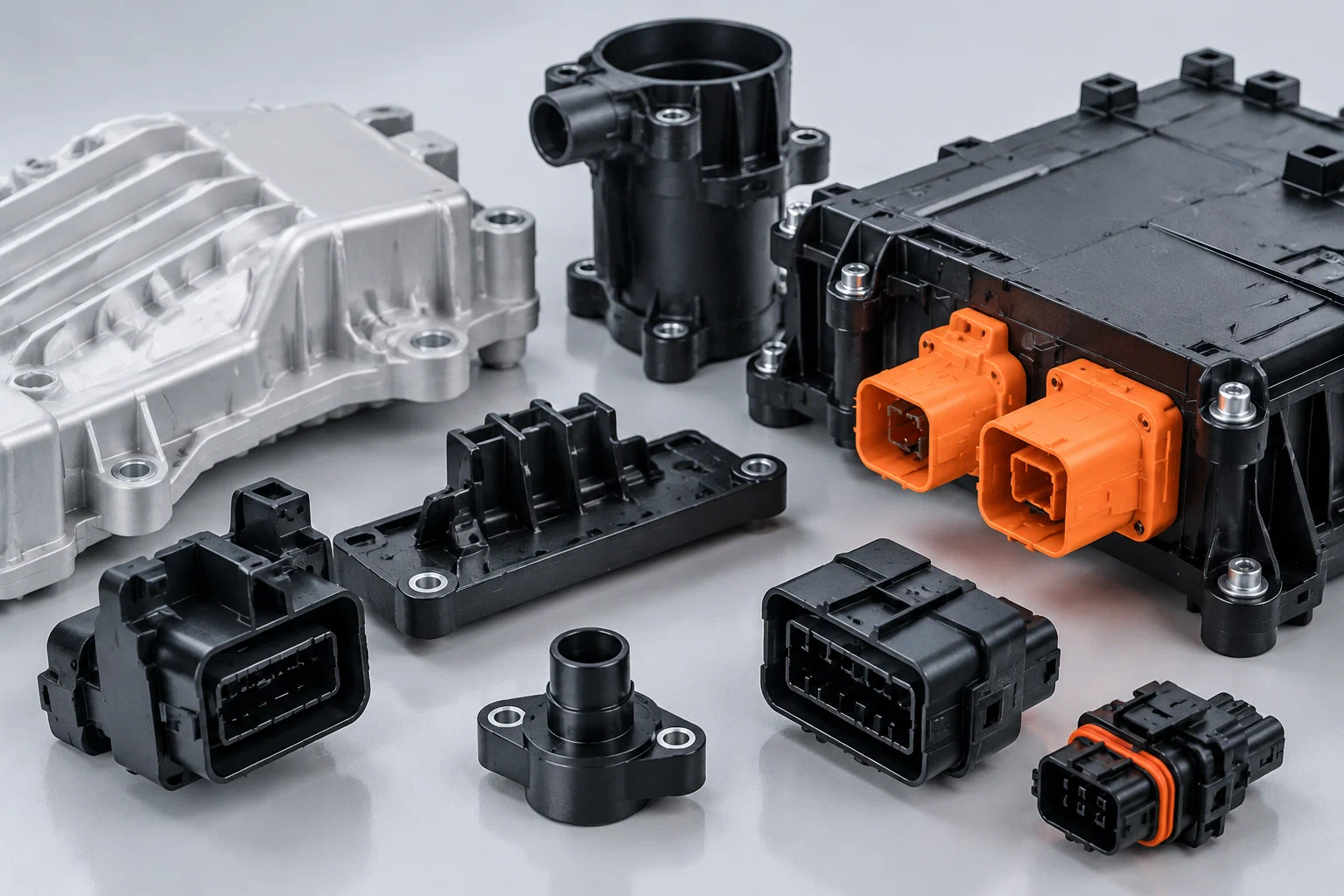
Plastic components used in electrical equipment and electric vehicles may look simple from the outside—a housing, bracket or connector—but material selection can have an impact on the entire manufacturing process once the component enters mass production. The material needs to meet flame-retardant requirements while providing sufficient strength and heat resistance, but it also needs to process reliably in an injection molding machine. As electrical components become smaller, thinner and more structurally complex, material selection can no longer be based only on a few numbers in a technical data sheet. Actual molding performance matters just as much.
On October 13, DOMO Chemicals introduced new 30% glass-fiber-reinforced halogen-free flame-retardant PA6 and PA66 compounds for applications including electrical and electronic components, electric mobility, batteries, charging stations and power electronics housings. Both materials focus on flame retardancy, electrical performance and mechanical properties. The PA6 solution places particular emphasis on flowability for complex injection-molded parts, while the PA66 solution is designed for thick-wall applications and offers glycol resistance for certain EV cooling-system components. The reported performance includes UL 94 V-0, GWFI 960°C and a CTI of 600 V.
The reason this development is interesting is fairly practical. In the past, material selection for many plastic components often started with two basic questions: can the material meet the required flame-retardant rating, and does it have enough strength? Anyone involved in actual injection molding knows that the situation can change once the material enters production. Glass fiber can significantly improve stiffness and strength, but it also affects flow, shrinkage and warpage. When a complex part is molded with a material that does not flow well enough, problems such as short shots, visible weld lines and dimensional variation can appear. A higher-specification material may solve one performance requirement while creating additional processing problems and costs somewhere else.
This is why material selection is increasingly becoming a matter of balance. PA6 GF30 and PA66 GF30 are both widely used reinforced nylon grades, but a standard grade is not automatically the right choice for every component. A thin-wall electrical housing may place more emphasis on flow and dimensional stability, while a structural component may require greater stiffness and long-term heat resistance. Certain EV components also need to withstand environments involving coolants and other chemicals. There is no single material that is simply “better” for every application. The more important question is whether the material matches the part design, operating environment and molding process.
This is where material modification can become useful in a real project. If a customer is already using PA6 or PA66 but is experiencing high material costs, insufficient flow, warpage or excessive material performance compared with what the product actually requires, the answer does not always have to be a more expensive or a lower-grade material. The formulation can be reviewed around the actual requirements of the component. Glass-fiber reinforcement, flame retardancy, toughness, flowability and heat resistance can be adjusted to create a better balance. The benefit is not limited to the resin price. A better material match can also affect molding stability, production cycle time and scrap rates.
This is one area where TechInherit can become involved directly. For PA6, PA66 and other engineering plastics requiring glass-fiber reinforcement, flame retardancy or toughness modification, TechInherit can evaluate the material around the customer's actual application and performance requirements. If a customer already has a production component, the existing material can also be reviewed together with the part design and molding results. When the component has high material costs, poor flow, warpage or unstable yield, the problem can be investigated from the material side as well as from the interaction between the material, part structure, mold and processing conditions. If the existing material is over-specified for the actual application, the material solution can also be reassessed rather than simply moving to a lower-quality grade.
For projects that are still in the development stage, material selection can be considered together with tooling and injection molding from the beginning. TechInherit provides material modification, product development, mold design and manufacturing, and injection molding capabilities, allowing material decisions to be connected with the actual production process. Questions such as how much flowability a complex structure requires, how glass-fiber content may affect warpage, or how a flame-retardant system may influence processing can be considered before tooling and mass production. Addressing these issues earlier can help reduce repeated mold trials and process adjustments later.
For purchasing teams, the practical value of this approach is that the final cost of a plastic component is rarely determined by resin price alone. Mold trials, injection cycle time, material waste, scrap and production adjustments all contribute to the finished cost. When these factors are considered together during material selection, the relationship between the material, mold and molding process becomes easier to manage. TechInherit's role is therefore not simply to provide a PA6 or PA66 grade, but to work around the customer's actual component and find a more suitable combination of material performance, tooling and injection molding conditions so that the part can be produced consistently without unnecessary material or manufacturing costs.
As electrical and EV components move toward higher flame resistance, greater strength, thinner walls and more complex structures, the role of an engineering plastics supplier is changing as well. Manufacturers increasingly need more than a material grade; they need a supplier that understands why a material is selected, how it will behave in the mold and how it can ultimately become a stable mass-produced component. For companies sourcing flame-retardant PA6, PA66, glass-fiber-reinforced nylon or other functional engineering plastics, this connection between material and manufacturing can be more valuable than simply comparing the price per kilogram.
Request a Free Design Review
Looking to reduce the cost of your next plastic injection molding project? Contact our engineering team today for a free consultation.
