
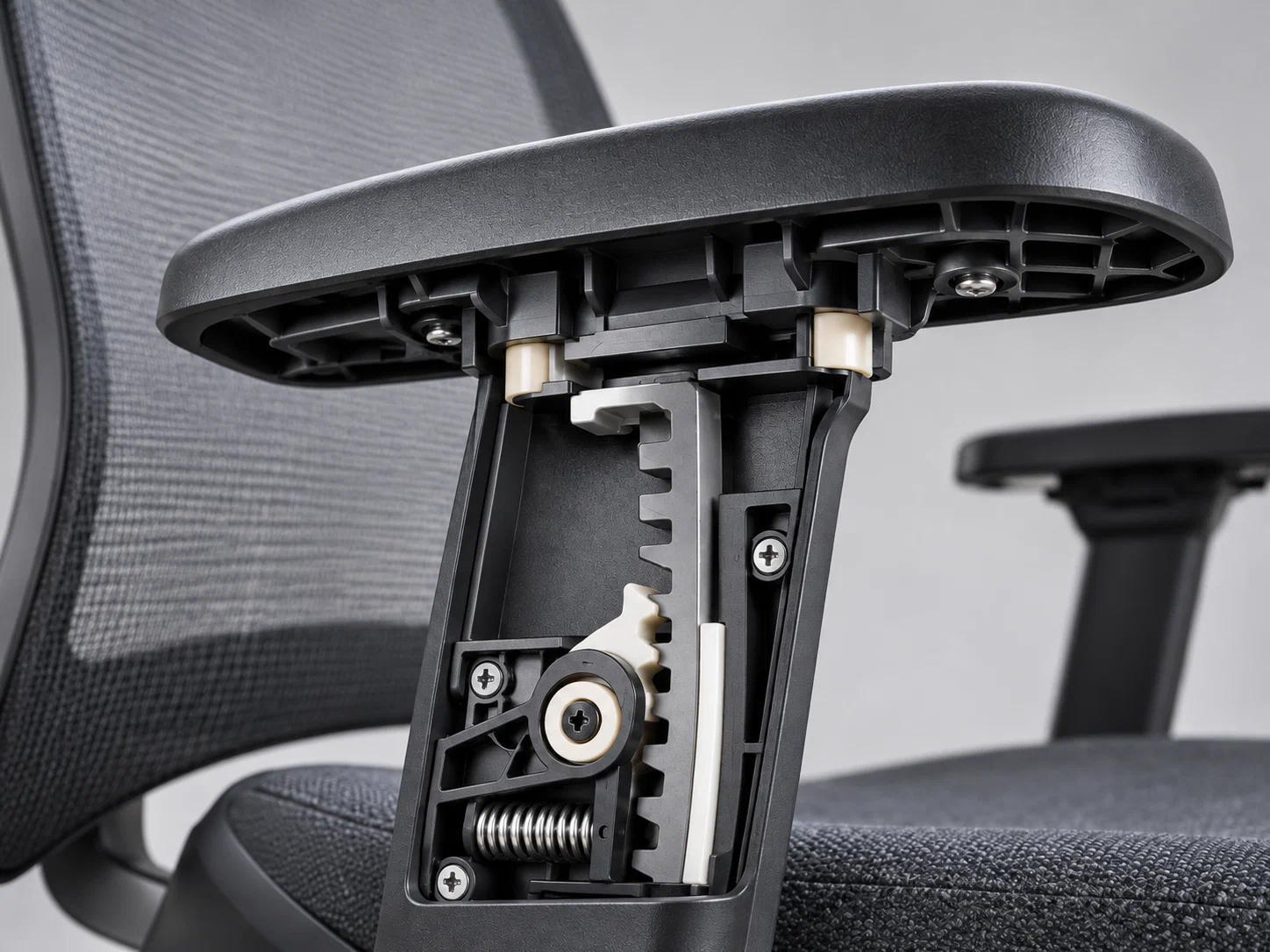
As ergonomic office chairs increasingly incorporate multiple adjustment functions, armrests are becoming more than simple support structures. They now integrate height adjustment, forward and backward movement, lateral positioning, and angular rotation. These functions rely on internal locking components, guide sliders, positioning clips, release buttons, and connecting supports working together. Although these plastic components are often relatively small, they directly influence adjustment feel, positional stability, and long-term service life. Under frequent adjustment and continuous loading, wear, loosening, or structural fatigue in functional components can prevent the armrest from locking accurately, create operating noise, or cause positional movement and jamming.
One of the most important requirements of a multi-position adjustment mechanism is reliable locking after every adjustment. Height-adjustment systems, for example, may use locking teeth, positioning features, or retaining clips to maintain the selected armrest height. Forward and backward adjustment systems rely on guide sliders and travel stops to control movement. Rotational mechanisms must maintain stable positioning at different angles. These functions are often achieved through the interaction of several plastic components and metal support structures. For manufacturers, the challenge is not simply controlling the external dimensions of individual parts. Locking positions, guide clearances, button travel, and the dimensional relationships between assembled components must all be considered. A deviation in one critical feature can affect the performance of the entire mechanism.
Wear in locking structures is a common concern during long-term operation. Plastic locking teeth and positioning clips experience repeated engagement and release. Over time, their contact surfaces may wear, increasing locking clearance and allowing the armrest to move slightly under load. Other mechanisms may develop inconsistent button return, increased slider resistance, or localized jamming. If a locking component has sharp corners, excessive wall-thickness variation, or concentrated stress around its root, repeated operation may also lead to fatigue cracking. Functional plastic component design should therefore consider contact area, tooth geometry, clip-root radii, guide surfaces, and actual loading directions rather than simply increasing component thickness.
Consider a typical development scenario involving a multi-position height-adjustable office chair armrest. Initial samples perform normally during lifting and locking tests, but after extended adjustment cycles, some mechanisms begin to show unreliable locking, slight movement, and inconsistent button operation. Further investigation indicates that the problem involves more than the wear resistance of the plastic material. Locking-tooth engagement depth, guide-slider clearance, and release-button travel also contribute to the overall performance. Simply replacing the original plastic with a higher-strength material may not resolve the issue if the locking geometry and guiding relationship remain unchanged. A more effective approach is to review tooth geometry, contact areas, clip loading positions, and slider guide length, then optimize the dimensional relationships between components according to actual assembly conditions. This helps the mechanism maintain reliable locking and release performance after repeated operation.
Different functional positions require different structural considerations. Locking components need accurate tooth geometry, sufficient engagement depth, and reliable retention under sustained loading. Guide sliders require controlled clearance, suitable contact areas, and consistent movement resistance. Excessive clearance can cause unwanted movement, while insufficient clearance may lead to jamming. Release buttons must provide appropriate travel, operating force, and return stability. Connecting clips and support components also require consideration of assembly methods, localized stress, and repeated disassembly requirements. These components do not necessarily need identical material or structural solutions. PA6, PA66, and toughened or reinforced modified nylon can be considered as material options, depending on loading, contact conditions, and actual operating requirements.
During mold development, locking teeth, thin retaining clips, guide channels, and complex connection structures require particular attention to molding quality. Poor gate positioning or weld lines located in highly stressed areas of a locking component may reduce local structural reliability. For components with multiple mating surfaces, shrinkage variation, critical dimensions, and demolding deformation must also be controlled to prevent inconsistent assembly during mass production. TechInherit's special functional injection molded parts solutions consider not only material performance but also component functions, geometry, and operating environments, helping ensure that customized plastic parts meet the actual requirements of the mechanism.
From product design to volume production, locking reliability and assembly consistency depend on coordinated tooling and manufacturing control. Through mold development, locking teeth, clips, sliders, and mounting structures can be optimized for manufacturability and dimensional accuracy. Combined with precision injection molding, this helps control critical dimensions, molding stability, and production consistency. For armrest mechanisms requiring repeated operation over an extended service life, validation should include adjustment-cycle testing, locking retention tests, button operating-force measurements, and assembly-clearance inspections. These tests help identify wear, loosening, jamming, and cracking after repeated cycles. TechInherit's existing office furniture plastic component cases also demonstrate manufacturing requirements related to load-bearing performance, fatigue resistance, and dimensional consistency.
For office chair manufacturers, the value of customized functional plastic components goes beyond enabling height adjustment and movement. It lies in ensuring that every operation remains smooth, stable, and reliable. When conventional locking structures cannot meet durability requirements, or existing supply solutions fail to resolve wear, looseness, and assembly deviations, redesigning the functional plastic components and their corresponding tooling can be more valuable than simply changing the material. Through targeted structural optimization and precision manufacturing, manufacturers can improve adjustment performance, reduce failure risks, and enhance the long-term quality of their office chair products.
Request a Free Design Review
Looking to reduce the cost of your next plastic injection molding project? Contact our engineering team today for a free consultation.
