
What Causes Low Strength in Plastic Components and How Materials Can Help
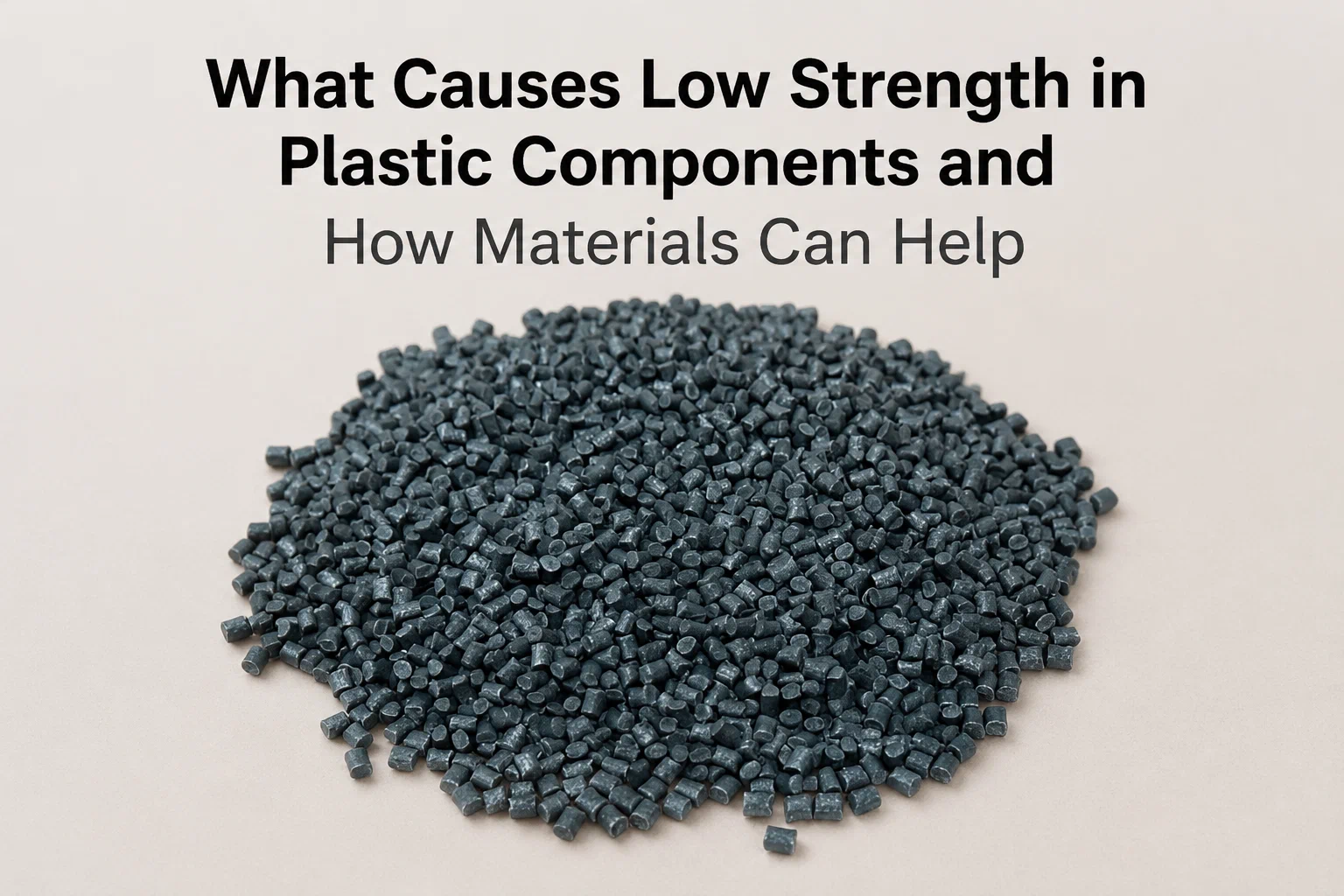
Plastic components can provide excellent weight reduction, design flexibility, and efficient production, but their mechanical strength is not automatically suitable for every application. When a plastic part fails under load, cracks around a stress point, or deforms during operation, the problem may be related to the material as much as the product design or manufacturing process.
Understanding the causes of insufficient strength is therefore important when developing plastic components for demanding applications.
Material Selection Is the First Factor
Different polymers have significantly different mechanical properties. A material that performs well for a housing or cover may not be suitable for a structural component that carries continuous loads.
Material selection should consider tensile strength, flexural strength, stiffness, impact resistance, operating temperature, and expected service conditions. Selecting a material based only on cost or basic processing characteristics can result in insufficient mechanical performance later in the product development process.
Engineering plastics such as PA6 and PA66 can provide higher mechanical performance than many general-purpose plastics. However, even standard engineering grades may not provide enough strength for applications with particularly high load requirements.
Reinforcement Can Increase Mechanical Strength
When a standard polymer does not provide sufficient strength or stiffness, reinforcement is one of the most common material modification approaches.
Glass fiber is widely used to reinforce engineering plastics. The fibers can improve tensile strength, stiffness, and dimensional stability, allowing the modified material to withstand higher mechanical loads.
Glass fiber reinforced PA6 and PA66 are examples of materials developed for applications where greater structural performance is required.
The reinforcement level also needs to be selected carefully. Increasing the amount of reinforcement can improve certain mechanical properties, but it may also influence toughness, flow behavior, surface appearance, and processing conditions.
Impact Resistance Is Different From Strength
A plastic material can have high stiffness or tensile strength while still being vulnerable to impact.
This distinction becomes important when components experience sudden loads, vibration, drops, or repeated mechanical impacts. Simply increasing reinforcement may not always provide the best solution.
Toughening modification can be used when improved impact resistance is required. The objective is to create a better balance between strength and toughness rather than maximizing one property alone.
Temperature Can Reduce Plastic Strength
Operating temperature can have a major effect on plastic performance.
Some materials become softer as temperature increases, resulting in reduced stiffness and load-bearing capability. Components that appear sufficiently strong at room temperature may deform when exposed to continuous heat.
For these applications, heat-resistant or heat-stabilized material formulations can help maintain mechanical properties under elevated temperatures.
Material selection should therefore consider the actual operating temperature rather than relying only on room-temperature test data.
Material Degradation Can Also Affect Strength
Long-term exposure to heat, chemicals, UV radiation, moisture, or repeated mechanical stress can gradually change polymer properties.
For example, certain nylon materials are sensitive to moisture absorption, which can affect dimensional stability and mechanical behavior. Thermal aging can also reduce performance over time.
If a component loses strength after prolonged use, the solution may require more than simply choosing a stronger initial material. The material needs to be evaluated against the actual environmental conditions of the application.
Processing Conditions Matter
Material selection alone does not guarantee a strong finished component.
Injection molding conditions can influence the final mechanical performance of a plastic part. Poor drying, unsuitable processing temperatures, inadequate filling conditions, or excessive internal stress can affect material properties and create weak areas.
Fiber-reinforced materials also require appropriate processing because fiber orientation can influence the strength of different areas of the molded component.
This means material development and injection molding should be considered together when optimizing component performance.
Material Modification Provides More Options
When standard materials cannot meet the required performance, material modification provides a way to develop a more suitable solution.
Depending on the application, modification may focus on:
- Glass fiber reinforcement for higher strength and stiffness
- Toughening modification for improved impact resistance
- Heat stabilization for elevated-temperature applications
- Functional additives for specific electrical or thermal requirements
- Special formulations for improved durability or environmental resistance
The appropriate approach depends on the actual failure mode and application requirements.
Strength Should Not Be Optimized Alone
Increasing one material property does not necessarily produce a better overall plastic component.
A high-strength material may have reduced toughness. A heavily reinforced material may become more difficult to process. A material optimized for high-temperature performance may have different cost and molding requirements.
Effective material development therefore focuses on finding the right balance between strength, toughness, thermal stability, dimensional stability, processability, and cost.
The most suitable material is not necessarily the strongest available grade. It is the material whose overall performance matches the actual requirements of the component.
A More Targeted Approach to Material Selection
When a plastic component has insufficient strength, engineers can begin by identifying how and where the failure occurs. The operating load, temperature, environment, molding conditions, and expected service life should then be evaluated together.
This information provides a basis for determining whether the solution requires a different polymer, reinforcement, toughening, thermal stabilization, or another type of material modification.
A targeted approach avoids simply increasing material strength without understanding the actual problem. It also provides greater flexibility when developing customized plastic components for specific applications.
Material modification can turn a standard engineering plastic into a more application-specific material with improved mechanical performance. Combined with appropriate product design and injection molding control, this approach can help manufacturers develop stronger and more reliable plastic components.
Techinherit provides customized material development and modified engineering plastic solutions, including reinforced PA6 and PA66, toughened nylon, functional plastics, and performance-optimized materials. Our material modification capabilities are designed to help customers address specific component requirements rather than relying solely on standard material grades.
Request a Free Design Review
Looking to reduce the cost of your next plastic injection molding project? Contact our engineering team today for a free consultation.
