
How to Improve the Surface Quality of Glass Fiber Reinforced Nylon (GF Nylon) Injection Molded Parts
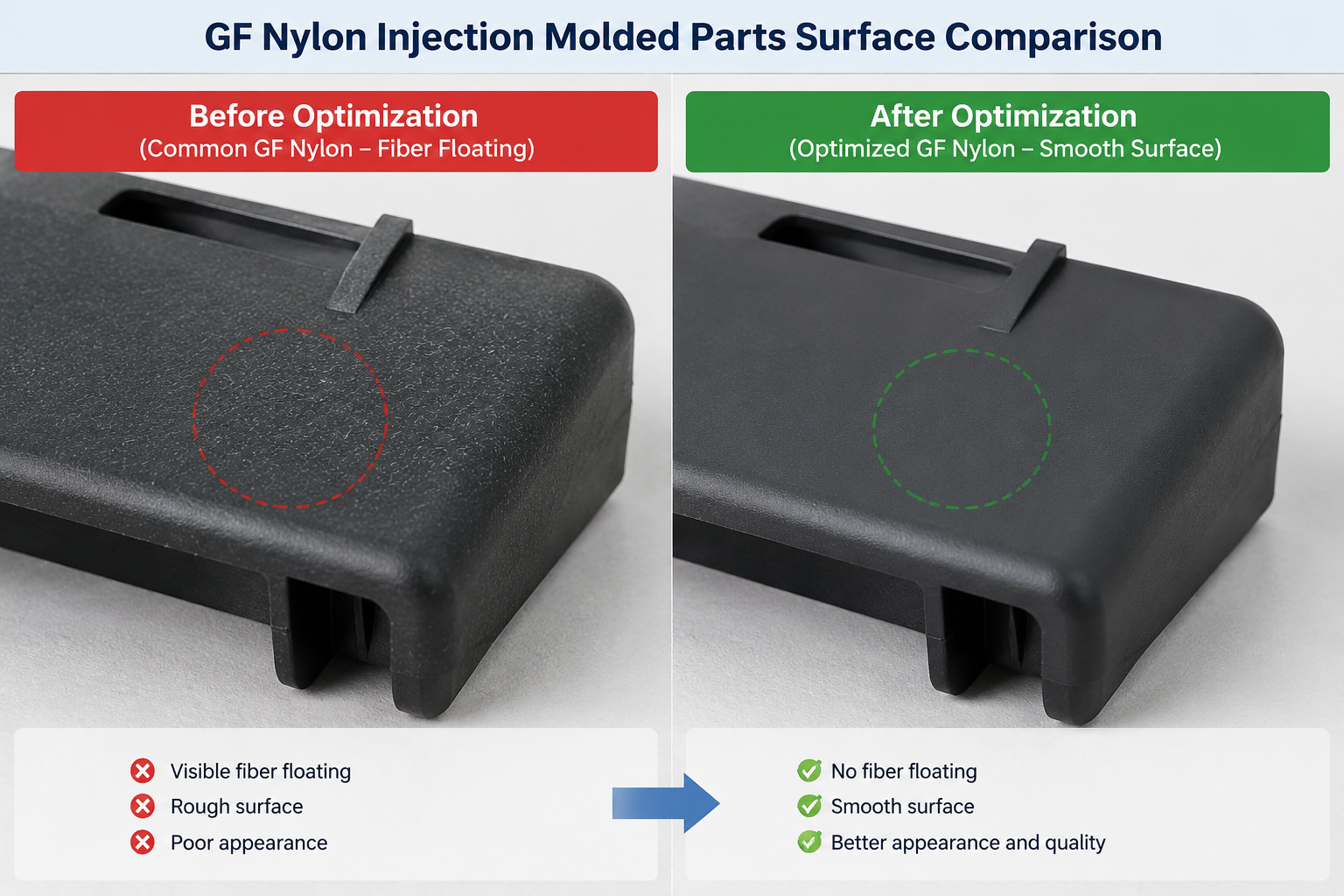
Glass fiber reinforced nylon (GF Nylon), such as PA6 GF30 and PA66 GF30, is widely used in automotive parts, electrical components, power tools, connectors, gears, and industrial applications due to its excellent strength, heat resistance, and dimensional stability.
However, during injection molding, many manufacturers encounter surface quality problems such as glass fiber floating, silver streaks, rough surfaces, weld marks, and uneven appearance.
These defects can affect the appearance, performance, and final acceptance of plastic parts.
As a professional modified nylon material manufacturer, Dongguan Zhonger New Materials provides customized material solutions and technical support to help customers improve injection molding quality.
1. Common Surface Problems of GF Nylon Parts
1. Glass Fiber Floating
Glass fiber floating is one of the most common problems in reinforced nylon injection molding.
It appears as visible glass fiber marks or a rough texture on the surface of the molded part.
Main causes include:
- Poor compatibility between resin and glass fiber
- Low melt temperature
- Insufficient injection pressure
- Improper mold design
- Excessive shear during injection
2. Poor Surface Gloss
Some GF nylon parts show a dull or uneven surface after molding.
Possible reasons:
- Material moisture
- Incorrect processing temperature
- Mold temperature too low
- Improper drying conditions
3. Weld Line and Flow Marks
When molten nylon flows and joins together inside the mold, weld lines may appear.
This can influence both appearance and mechanical strength.
2. Optimize Injection Molding Parameters
Proper injection molding conditions are essential for improving GF nylon surface quality.
Increase Melt Temperature
Higher melt temperature can improve the flowability of nylon material and help glass fibers distribute more evenly.
However, excessive temperature may cause:
- Material degradation
- Color change
- Gas generation
The processing temperature should be adjusted according to the specific PA6 or PA66 grade.
Increase Injection Speed and Pressure
Higher injection speed can reduce the exposure of glass fibers on the surface.
Optimizing injection pressure helps:
- Improve filling performance
- Reduce flow marks
- Improve surface appearance
Adjust Mold Temperature
A suitable mold temperature helps the polymer chains flow better and improves surface replication.
For high-quality appearance requirements, a higher mold temperature is usually beneficial.
3. Improve Mold Design
Mold design plays an important role in GF nylon surface quality.
Recommended improvements:
Optimize Gate Position
A proper gate location can reduce:
- Fiber orientation problems
- Weld lines
- Surface defects
Improve Runner and Gate Size
Insufficient runner or gate size may increase shear stress and damage glass fibers.
Add Proper Venting
Poor ventilation can cause:
- Burn marks
- Gas marks
- Surface defects
Proper exhaust design helps achieve a smoother surface.
4. Choose the Right Modified Nylon Material
Material selection is one of the key factors affecting surface quality.
Different applications require different formulations.
For example:
PA6 GF30
Advantages:
- Good processing performance
- Excellent impact resistance
- Good surface appearance
Applications:
- Electrical parts
- Sports equipment
- Power tools
PA66 GF30
Advantages:
- Higher temperature resistance
- Higher mechanical strength
- Better dimensional stability
Applications:
- Automotive components
- Connectors
- Structural parts
For products requiring better appearance, manufacturers can choose specially modified GF nylon grades with:
- Improved glass fiber dispersion
- Better resin-fiber compatibility
- Lower fiber exposure
- Better injection flow performance
5. Control Material Drying
Nylon is a moisture-sensitive engineering plastic.
Insufficient drying may cause:
- Silver streaks
- Bubbles
- Poor surface finish
- Mechanical performance reduction
Before injection molding, nylon materials should be properly dried according to the material specification.
6. Reduce Recycled Material Ratio
Using excessive recycled material may affect:
- Molecular weight
- Surface appearance
- Mechanical properties
For high-quality plastic parts, controlling recycled material content is important.
Professional GF Nylon Material Solutions from Dongguan Zhonger New Materials
Dongguan Zhonger New Materials specializes in PA6, PA66, and customized modified nylon materials.
With our own:
- Material R&D department
- Injection molding workshop
- Mold department
- Quality inspection system
- Third-party testing support
We provide one-stop solutions from material selection to injection molding optimization.
Our modified nylon materials are widely applied in:
- Automotive parts
- EV charging connectors
- Electrical components
- Ergonomic chair parts
- Sports equipment
- Industrial products
If you are facing problems such as glass fiber floating, poor surface quality, deformation, or insufficient strength, our technical team can provide customized material recommendations.
Contact us for professional GF nylon material solutions.
Request a Free Design Review
Looking to reduce the cost of your next plastic injection molding project? Contact our engineering team today for a free consultation.
