
Why Does My Nylon Part Deform After Injection Molding? Causes and Solutions
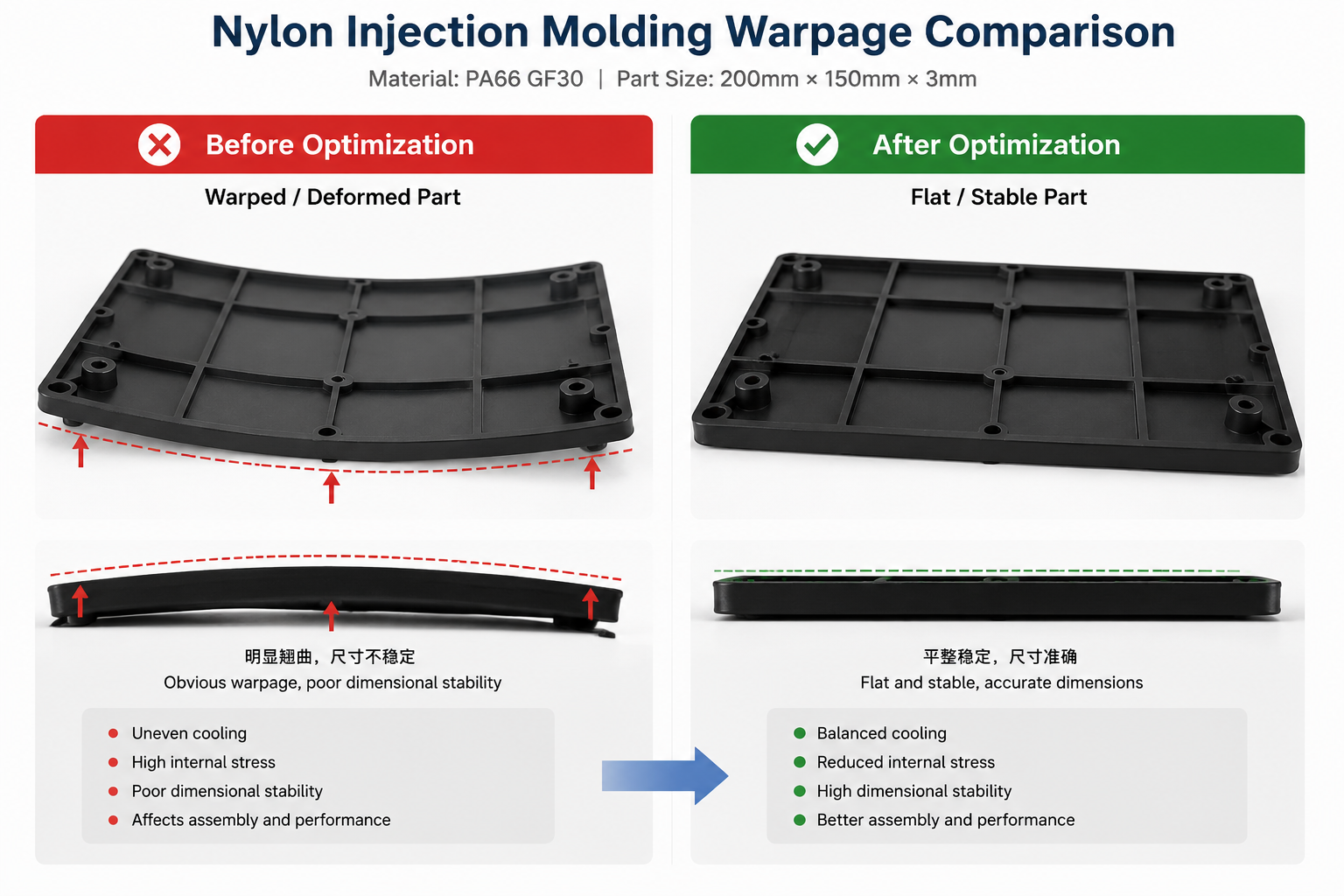
Nylon materials, including PA6 and PA66, are widely used in automotive parts, electrical components, industrial products, gears, and ergonomic chair components due to their excellent strength, wear resistance, and heat resistance.
However, during injection molding, many manufacturers encounter a common problem:
Why does my nylon part deform after injection molding?
Warping and deformation can affect:
- Product assembly accuracy
- Dimensional stability
- Mechanical performance
- Customer acceptance
Understanding the causes of nylon deformation and applying the correct solutions can significantly improve product quality.
As a professional modified nylon material manufacturer, Dongguan Techinherit provides customized material solutions and injection molding support to help customers solve plastic part deformation problems.
1. What Causes Nylon Parts to Deform After Injection Molding?
1. Uneven Shrinkage During Cooling
Nylon parts shrink during the cooling process after injection molding.
If different areas of the part cool at different speeds, internal stress will be generated, causing:
- Warpage
- Bending
- Twisting
- Dimensional deviation
Common causes:
- Uneven wall thickness
- Poor cooling system design
- Different cooling rates in different areas
2. Improper Injection Molding Parameters
Injection process settings have a major impact on nylon part deformation.
Insufficient Holding Pressure
If holding pressure is too low:
- The material cannot fully compensate for shrinkage
- Internal voids may appear
- Dimensions become unstable
Excessive Injection Pressure
Too much pressure may cause:
- High internal stress
- Molecular orientation problems
- Post-molding deformation
Incorrect Cooling Time
Insufficient cooling time means the part is not fully solidified before ejection.
This can lead to:
- Bending after removal from the mold
- Long-term dimensional changes
3. Glass Fiber Orientation Problems
Glass fiber reinforced nylon, such as:
- PA6 GF30
- PA66 GF30
- PA66 GF50
is widely used for high-strength applications.
However, glass fibers flow in a specific direction during injection molding.
Uneven fiber orientation may cause:
- Different shrinkage rates
- Uneven strength distribution
- Warpage problems
For example, a large flat component made from PA66 GF30 requires careful consideration of:
- Gate location
- Fiber flow direction
- Mold filling balance
4. Poor Mold Design
Mold design is one of the key factors affecting nylon part stability.
Important factors include:
Gate Design
Incorrect gate location may cause:
- Uneven filling
- Different shrinkage areas
- Stress concentration
Cooling System
A balanced cooling system helps:
- Reduce temperature differences
- Improve dimensional stability
- Reduce deformation
Mold Venting
Poor venting can cause:
- Uneven filling
- Internal stress
- Product deformation
5. Material Selection Is Critical
Different nylon materials have different shrinkage and performance characteristics.
Choosing the wrong material may result in deformation problems.
PA6
Advantages:
- Good toughness
- Good impact resistance
- Better flow performance
Suitable for:
- General mechanical parts
- Sports equipment
- Consumer products
PA66
Advantages:
- Higher strength
- Better heat resistance
- Better dimensional stability
Suitable for:
- Automotive parts
- Connectors
- Structural components
PA66 GF30
Glass fiber reinforced PA66 provides:
- Higher rigidity
- Lower shrinkage
- Better dimensional stability
- Improved load-bearing capability
Common applications:
- Automotive components
- Gears
- Ergonomic chair bases
- Industrial structural parts
6. How to Reduce Nylon Part Deformation?
Optimize Material Drying
Nylon absorbs moisture easily.
Before molding, proper drying is necessary to avoid:
- Gas marks
- Reduced strength
- Dimensional instability
Improve Mold Design
Recommended improvements:
- Optimize gate position
- Balance runner system
- Improve cooling channels
- Increase mold temperature control accuracy
Adjust Injection Parameters
Optimize:
- Injection speed
- Injection pressure
- Holding pressure
- Cooling time
according to the specific product design.
Select Modified Nylon Material
For products requiring high dimensional stability, modified nylon materials can provide better performance.
Examples:
PA66 GF30
Recommended for:
- High-load structural parts
- Chair bases
- Automotive parts
PA66 Toughened Nylon
Recommended for:
- Impact-resistant products
- Cold environment applications
Low Warpage Nylon
Recommended for:
- Precision components
- Large-size plastic parts
7. Professional Nylon Material Solutions from Dongguan Techinherit
Dongguan Techinherit specializes in the development and production of customized modified nylon materials.
Our capabilities include:
✔ Material formulation development
✔ PA6 / PA66 engineering plastics
✔ Glass fiber reinforced nylon
✔ Flame retardant nylon
✔ Toughened nylon solutions
✔ Injection molding technical support
With our own:
- Material R&D department
- Mold department
- Injection molding workshop
- Quality inspection system
we help customers solve problems such as:
- Product deformation
- Poor surface quality
- Insufficient strength
- Injection molding defects
Our materials are widely used in:
- Ergonomic chair components
- Automotive parts
- Electrical connectors
- Industrial products
- Consumer goods
Conclusion
Nylon part deformation after injection molding is usually caused by a combination of:
- Material properties
- Mold design
- Injection parameters
- Cooling conditions
By selecting the correct nylon grade and optimizing the molding process, manufacturers can significantly improve dimensional stability and product performance.
If you are facing nylon injection molding deformation problems, Dongguan techinherit can provide professional modified nylon material solutions based on your application requirements.
Request a Free Design Review
Looking to reduce the cost of your next plastic injection molding project? Contact our engineering team today for a free consultation.
