
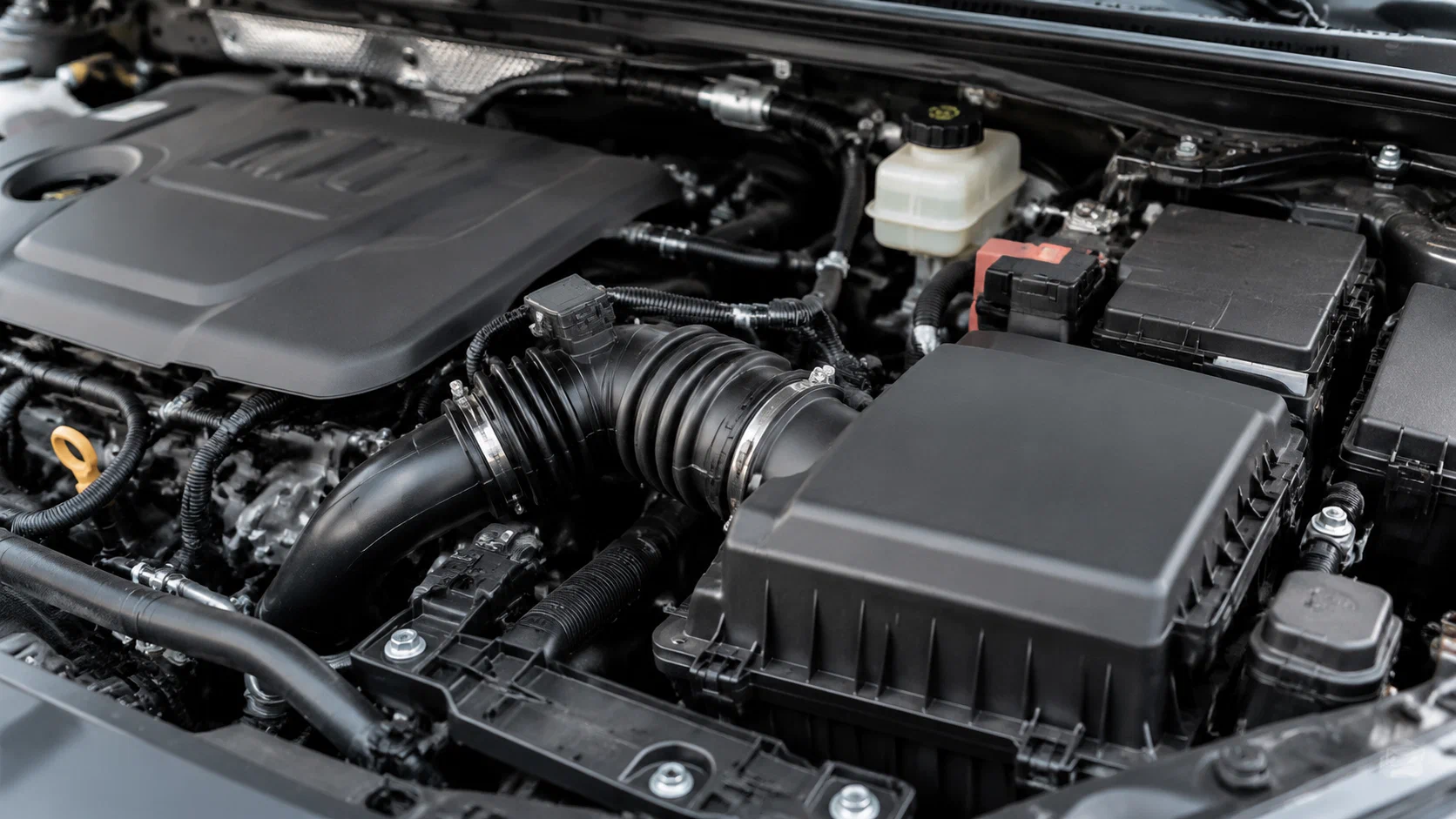
1. Thermal Performance Requirements for PA6/PA66 in Engine Compartments
In automotive engine compartments, plastic parts near exhaust manifolds, turbochargers, and cylinder blocks are exposed to long-term temperatures of 120°C–150°C, with local peaks exceeding 170°C. These parts also endure bolt preload, vibration, and thermal cycling. Standard PA6/PA66 has an HDT of only 70°C–90°C (at 0.45 MPa), far below engine compartment requirements. Therefore, glass fiber reinforcement, thermal stabilization, and crystallinity control are needed to raise HDT above 200°C and ensure dimensional stability under sustained load. Two key indicators must be evaluated: HDT reflects short-term heat resistance, while long-term creep determines dimensional stability under continuous load at high temperature.
2. Relationship Between Glass Fiber Reinforcement and HDT Improvement
Glass fiber reinforcement is the most direct and effective way to increase the HDT of PA6/PA66. Chopped glass fibers form a rigid skeleton in the nylon matrix, bearing most of the load at elevated temperatures and significantly suppressing softening of the resin. Typically, PA66 with 30% chopped glass fiber can raise HDT (at 1.82 MPa) from about 70°C to over 240°C. Higher glass fiber content further improves HDT, but reduces toughness, flowability, and surface quality. For engine compartment parts, 30%–35% glass fiber is recommended to meet HDT requirements while retaining sufficient impact resistance. Fiber length and dispersion uniformity also affect HDT; long-fiber reinforced systems (LFT) offer better creep resistance at high temperatures than short-fiber systems.
3. Influence of Thermal Stabilization on Long-Term Heat Aging
Engine compartment parts face not only short-term high temperatures but also long-term thermal-oxidative aging. Under high-temperature aerobic conditions, PA6/PA66 molecular chains undergo thermal-oxidative degradation, leading to reduced molecular weight, embrittlement, lower HDT, and accelerated creep. To inhibit this, an effective thermal stabilization system is required. Copper salt/potassium iodide complex stabilizers are classic for nylon, especially PA6 and PA66, effectively suppressing thermal-oxidative degradation above 150°C for long periods. Combining hindered phenolic primary antioxidants with phosphite secondary antioxidants further improves long-term heat aging performance. For engine compartment parts, a copper salt complex with hindered phenolic/phosphite co-stabilizers is recommended to ensure that after long-term aging at 150°C, HDT and mechanical property retention remain above 80%.
4. Relationship of Long-Term Creep with Molecular Weight and Crystallinity
Long-term creep is a common failure mode for engine compartment parts. Under high temperature and sustained load, PA6/PA66 molecular chains slowly slide and rearrange, causing gradual dimensional increase or permanent deformation. Creep rate is closely related to matrix molecular weight, crystallinity, and glass fiber orientation. High-molecular-weight PA66 has more chain entanglement and better creep resistance; high crystallinity reduces the amorphous fraction and lowers the possibility of chain sliding; glass fibers oriented along the load direction effectively bear the load and suppress creep. Therefore, high-temperature creep-resistant modification should use high-molecular-weight virgin resin, add nucleating agents to increase crystallinity, and optimize gate location so fiber orientation aligns with the main load direction. For parts with extreme creep requirements, annealing can further release internal stress and improve dimensional stability.
5. Synergistic Control of Creep and Heat Deflection Through Structural Design and Injection Molding
Even with optimal formulation, improper structural design and injection molding can still cause deformation or creep failure of engine compartment parts at high temperatures. For structural design, avoid abrupt wall thickness changes and sharp corners; set sufficient fillets at all corners to reduce stress concentration; control rib thickness at 50%–60% of the main wall to prevent sink marks and internal stress; for bolt holes under sustained load, add metal inserts or increase wall thickness to distribute the load. For injection molding, mold temperature should be 80°C–120°C to promote sufficient crystallization; holding pressure should be 60%–80% of injection pressure, lasting until gate freeze to reduce internal voids and residual stress. After demolding, parts can be annealed at 120°C–150°C to release internal stress and promote post-crystallization, significantly improving long-term creep resistance.
Request a Free Design Review
Looking to reduce the cost of your next plastic injection molding project? Contact our engineering team today for a free consultation.
