
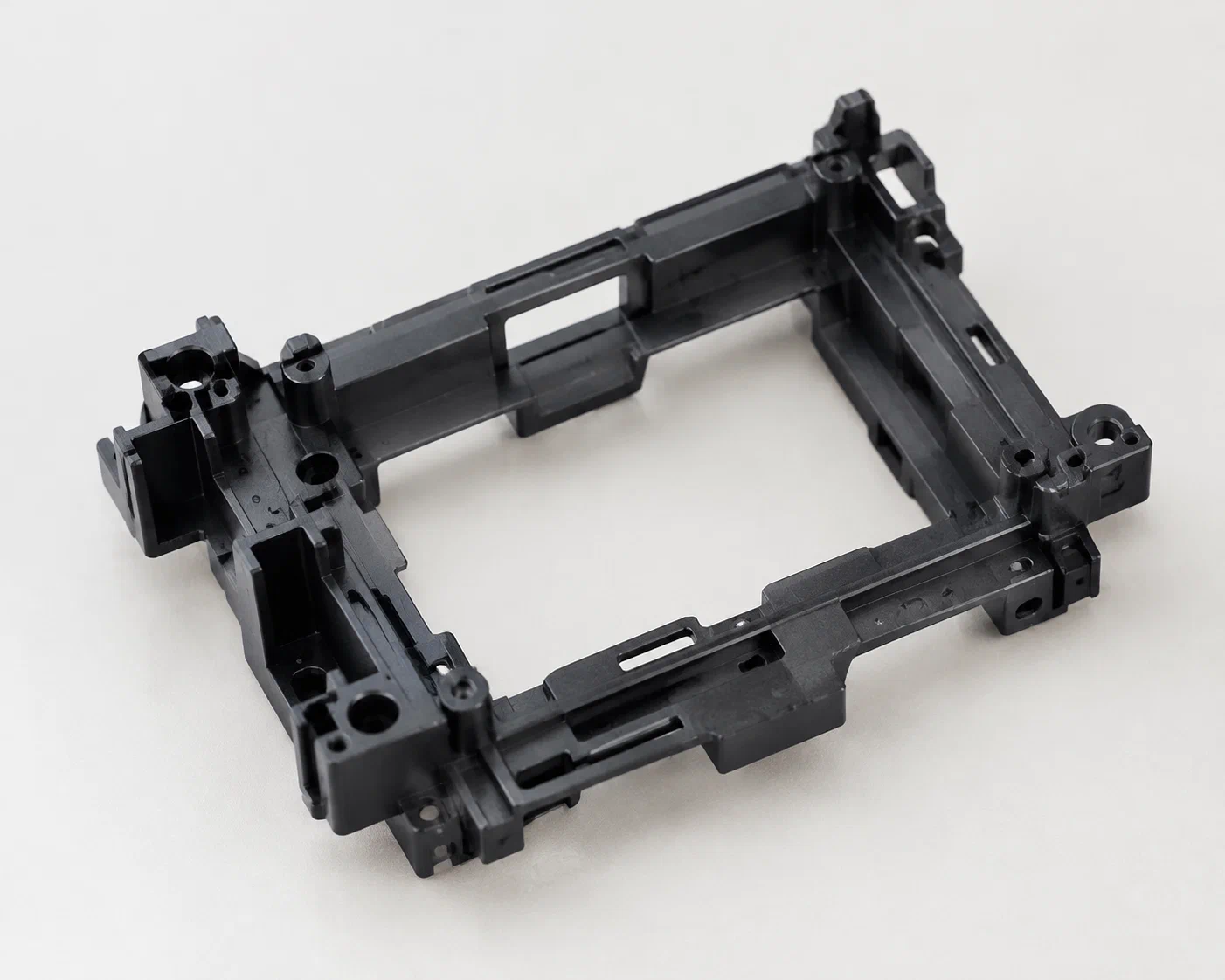
1. Warpage Sources and Low Warpage Requirements for Precision Electronic Brackets
Precision electronic brackets are widely used in connectors, sensors, relays, optical modules, and chip test sockets. Requirements for flatness, hole position accuracy, and assembly clearance are typically within ±0.02 mm to ±0.05 mm. Although glass fiber reinforced PA6/PA66 provides sufficient rigidity and heat resistance, glass fibers orient highly along the flow direction during injection filling, resulting in a shrinkage difference of 0.5%–1.0% between the flow direction and the transverse direction. This is the primary cause of bracket warpage. In addition, residual internal stress generated during injection molding due to uneven cooling, insufficient holding pressure, and improper demolding will slowly release after demolding, causing secondary deformation. Therefore, low warpage modification must simultaneously address two core issues: "shrinkage anisotropy" and "internal stress release."
2. Mineral Filler Compounding System and Shrinkage Balance Design
The most effective way to reduce warpage is to introduce isotropic mineral fillers compounded with glass fibers. Talc, mica powder, and glass beads are three common choices: talc has a moderate aspect ratio, provides a certain planar reinforcement effect, and its isotropic shrinkage can effectively neutralize the shrinkage difference caused by glass fiber orientation; mica powder has a larger aspect ratio and more significant planar reinforcement effect, contributing notably to warpage reduction, but it is more expensive and reduces impact toughness; glass beads are spherical, have the best isotropy, and can significantly improve flowability and dimensional stability, but their reinforcement effect is limited. In actual formulas, it is recommended to control glass fiber content at 10%–20% and mineral filler content at 10%–20%, balancing rigidity, toughness, and shrinkage by adjusting the ratio. Meanwhile, all fillers need silane coupling agent surface treatment to ensure good interfacial bonding with the nylon matrix and reduce local shrinkage anomalies caused by debonding.
3. Annealing and Moisture Conditioning Process for Internal Stress Release
After injection molding, precision electronic brackets contain residual internal stress generated by uneven cooling shrinkage, glass fiber orientation, and holding pressure differences. This internal stress slowly releases at room temperature, causing bracket warpage within hours to days. Annealing is the core process for releasing internal stress: place the parts in a circulating hot air oven at 120°C–140°C, hold for 2–4 hours, then slowly cool to room temperature with the oven. During annealing, nylon molecular chains gain sufficient energy to rearrange, residual stress relaxes, and post-crystallization is promoted, improving dimensional stability. For PA6/PA66, which is sensitive to moisture absorption, moisture conditioning can be performed after annealing: place the parts in an environment at 80°C and 65% relative humidity for 24–48 hours to allow the material to reach moisture absorption equilibrium, avoiding dimensional drift caused by moisture expansion during subsequent use.
4. Injection Molding and Mold Cooling System Optimization
The injection molding process is critical for warpage control. Mold cooling channels must ensure symmetrical cooling rates on both the moving and fixed mold sides to avoid bending deformation caused by faster cooling on one side. For precision electronic brackets, it is recommended to use multiple independently temperature-controlled cooling circuits to ensure uniform mold temperature across the cavity, with mold temperature controlled at 80°C–100°C. Gate design should avoid single pin-point gates; fan gates or submarine gates are preferred to ensure balanced melt flow in the cavity and reduce excessive glass fiber orientation. Holding pressure should be set at 60%–80% of injection pressure, and holding time should last until the gate is completely frozen to compensate for volume loss during cooling shrinkage. Medium-low speed multi-stage injection should be used to avoid high shear orientation and internal stress caused by high-speed filling. After demolding, parts should be immediately placed in setting fixtures for slow cooling to prevent warpage from free shrinkage.
5. Synergistic Control of Crystallization Behavior and Long-Term Dimensional Stability
PA6/PA66 is a semi-crystalline polymer. The degree of crystallinity and uniformity of crystalline region distribution directly affect shrinkage and long-term dimensional stability. Insufficient or uneven crystallization leads to continued "post-crystallization" after demolding, causing continuous dimensional changes. To obtain low-warpage and dimensionally stable precision electronic brackets, 0.2%–0.5% of a high-efficiency nucleating agent, such as organic carboxylate or ultrafine talc, should be added to the formula to promote rapid and uniform crystallization during cooling, refine grains, and reduce interfacial defects between crystalline and amorphous regions. At the same time, mold temperature and cooling rate should be strictly controlled to avoid insufficient crystallization from overly fast cooling or coarse grains from overly slow cooling. For precision electronic brackets in long-term service, the moisture expansion and creep behavior of the material under high-temperature and high-humidity environments must also be evaluated to ensure assembly accuracy and stable electrical performance throughout the product life.
Request a Free Design Review
Looking to reduce the cost of your next plastic injection molding project? Contact our engineering team today for a free consultation.
