
Why Do EV Charging Plastic Components Crack in Cold Weather?
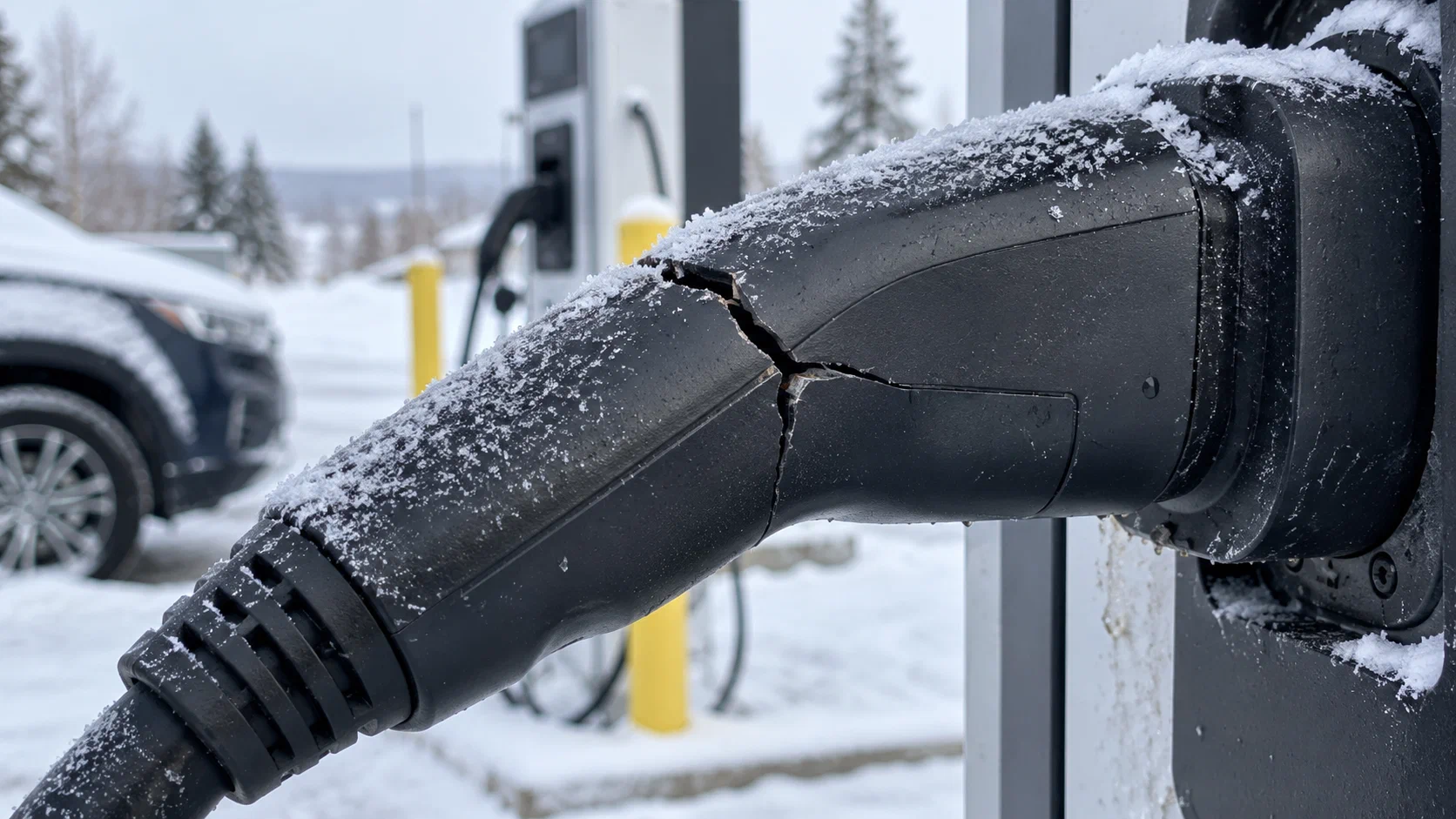
EV charging guns and connectors may look relatively simple, but plastic components used in cold climates can face much harsher conditions than parts used indoors. In northern regions of North America, Northern Europe, and other areas with severe winters, charging equipment may remain outdoors for long periods while exposed to low temperatures, snow, moisture, and repeated temperature changes. A plastic component that performs normally at room temperature may pass a standard drop or assembly test and still develop cracks, broken snap-fits, or damaged mounting areas during winter use.
When this happens, the first assumption is often that there is a problem with the product design or injection molding process. However, the low-temperature performance of the material itself also needs to be considered. As temperature decreases, molecular movement within many plastics becomes more restricted, and their toughness can change significantly. A material that has acceptable impact performance at room temperature may become more brittle at lower temperatures. If the part already contains sharp corners, thin sections, weld lines, or residual stress from molding, cold conditions can make these weaknesses much more noticeable. For example, an EV charging gun housing may survive a drop test at room temperature but develop a crack around a snap-fit, screw mounting point, or structural corner when the same type of impact occurs during winter.
This is why material selection for EV charging equipment used in cold regions should not be based only on tensile strength or stiffness at room temperature. The more important question is whether the material can maintain sufficient toughness at the actual operating temperature. The way the part is used also matters. A charging connector that is frequently plugged and unplugged, dropped, or subjected to assembly stress has very different requirements from a plastic component that remains stationary inside a protected enclosure. Outdoor applications also introduce long-term weathering and temperature cycling, which can further affect material performance.
PA6 and PA66 are commonly considered for engineering plastic components of this type, but choosing between them cannot be determined simply by looking at the material name. Glass-fiber-reinforced PA6 or PA66 can provide high strength and stiffness and is therefore widely used for structural injection-molded components. However, once glass fiber is added, other factors such as low-temperature toughness, fiber orientation, shrinkage, and warpage also need to be considered. If a charging component requires both high mechanical strength and good impact resistance in extremely cold conditions, simply increasing the glass-fiber content is not necessarily the best solution.
This is where material modification becomes useful. For charging gun housings, connector structures, snap-fits, and similar components that need better low-temperature toughness, PA6 or PA66 can be modified according to the actual operating temperature and part requirements. A toughened formulation can help the material maintain better impact resistance at low temperatures while retaining the mechanical properties needed for the application. In practice, however, low-temperature performance is rarely the only requirement. A customer may also need flame retardancy, mechanical strength, dimensional stability, and suitable injection molding flowability. These properties can influence one another. Some flame-retardant systems can affect toughness, while increasing stiffness too aggressively may make a component more sensitive to impact at low temperatures. The material therefore needs to be developed around the actual application rather than optimized for a single property.
Another issue that is often overlooked is residual stress created during injection molding. Even when the material itself has good low-temperature performance, excessive internal stress can make a molded component more likely to crack after exposure to cold temperatures. Gate location, injection speed, holding pressure, cooling conditions, and changes in wall thickness can all influence the final stress state. With glass-fiber-reinforced materials, fiber orientation during filling can also affect shrinkage and mechanical behavior in different areas of the part. If cracks repeatedly appear in the same location, it is therefore not enough to conclude that the material simply has poor cold-weather performance. The part design and molding process need to be considered as well.
For this reason, when an EV charging connector develops cracks in cold conditions, replacing the material immediately is not always the most effective approach. The location and appearance of the crack should first be examined together with the part geometry, material grade, reinforcement system, and molding conditions. If the material does not provide enough toughness at the target temperature, a toughened low-temperature PA6, PA66, or another suitable engineering plastic may be considered. If the material itself is not the main issue, further work may be required on the mold and injection process to address residual stress, fiber orientation, or localized structural stress.
TechInherit approaches these projects by looking at the material and the molded component together. We can evaluate material selection based on operating temperature, mechanical load, flame-retardant requirements, and part structure, while also developing modified PA6, PA66, and other engineering plastics for specific performance requirements. Our capabilities also cover mold development and injection molding, allowing the material solution to be considered together with the manufacturing process. For customers who already have a product design but are experiencing cracking, broken snap-fits, or dimensional changes during low-temperature testing, the objective is to identify the actual cause rather than simply recommend another material grade.
For EV charging equipment used in cold climates, low-temperature performance is not an isolated material property. Material toughness, part geometry, mold design, and injection molding conditions can all influence whether a plastic component remains reliable in winter conditions. If an EV charging plastic component begins to crack or fail under low-temperature impact, the material should be evaluated alongside the product design and molding process to determine whether the complete solution is properly matched to the actual application.
Request a Free Design Review
Looking to reduce the cost of your next plastic injection molding project? Contact our engineering team today for a free consultation.
