
Why Do Plastic Gears Wear Prematurely in Industrial Automation Equipment?
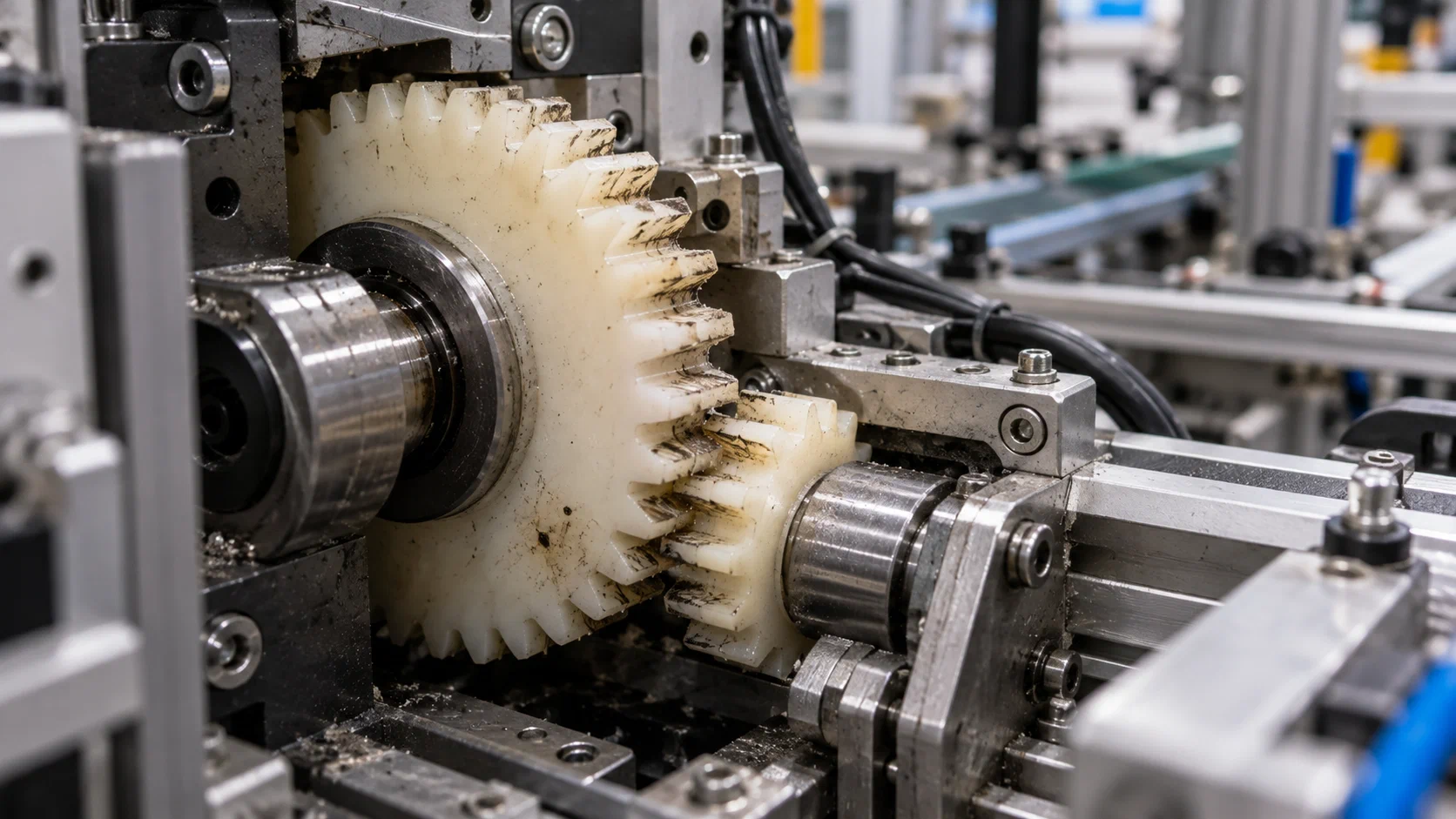
Plastic gears are widely used in automated conveyor systems, positioning mechanisms, and compact drive assemblies that operate for long periods. A gear may run smoothly when a machine is first commissioned, but after several months, wear can develop on the tooth surfaces, backlash may increase, and operating noise may become more noticeable. In severe cases, gear teeth can break. Replacing the gear may temporarily restore performance, but if the underlying cause remains, the same failure can return, increasing spare-part costs and maintenance time.
Switching to a stronger material is not always the answer. Premature wear can result from a combination of load, rotational speed, frictional heat, gear engagement, and material properties. If tooth contact is uneven, certain teeth may carry excessive pressure even when the material has good wear resistance. In high-speed or continuously operating systems, frictional heat can also affect mechanical performance. Examining the wear pattern, tooth surfaces, and actual operating conditions is therefore more useful than simply selecting a material with higher strength.
POM, PA6, or PA66: Which Material Fits the Application?
POM is often considered for precision plastic gears because of its relatively low coefficient of friction and good dimensional stability. PA6 and PA66 offer good mechanical strength and toughness, making them worth evaluating for some applications with higher load requirements. However, nylon absorbs moisture, which can change its dimensions and affect the clearance between meshing gears. When transmission accuracy is important or operating humidity varies significantly, these changes should be considered during material selection.
For gears that wear too quickly, the choice between POM, PA6, PA66, or another engineering plastic should be based on the load, rotational speed, operating temperature, lubrication conditions, and material of the mating gear. If a standard grade cannot provide the required service life, a wear-modified formulation may be worth evaluating. TechInherit’s material modification capabilities can support the assessment of different formulations, but the appropriate solution still depends on the actual operating conditions. Adding glass fiber or increasing stiffness does not automatically improve tooth wear, particularly when the friction behavior and wear of the mating gear are also important.
Why Can Gears Continue to Wear After a Material Change?
Sometimes the problem is not entirely related to material performance. Manufacturing accuracy can also affect gear life. Injection-molded gears are sensitive to mold precision, material shrinkage, gate location, and cooling conditions. If the tooth profile is inaccurate or shrinkage varies across the part, the gears may not engage evenly, concentrating pressure on certain teeth. In this situation, switching to a more wear-resistant material may not solve the underlying problem.
The right improvement depends on the failure mechanism. If frictional wear is the main issue, material properties, operating temperature, and lubrication should be assessed. If wear is concentrated on particular teeth, gear engagement, load distribution, and part geometry deserve closer attention. When dimensional deviations or unstable backlash are also present, mold design and injection molding conditions should be examined. Evaluating material modification alongside mold precision and molding conditions provides a more complete approach than changing the material alone.
For industrial automation equipment that must operate reliably over long periods, a plastic gear needs to maintain acceptable wear performance, dimensional accuracy, and transmission stability—not simply meet an initial strength requirement. Selecting an appropriate engineering plastic and, where necessary, adjusting the formulation, gear design, and molding conditions can help extend service life and reduce repeated replacement and maintenance costs.
Request a Free Design Review
Looking to reduce the cost of your next plastic injection molding project? Contact our engineering team today for a free consultation.
