
Why Do Plastic Office Chair Armrests Crack Around Screw Mounts?
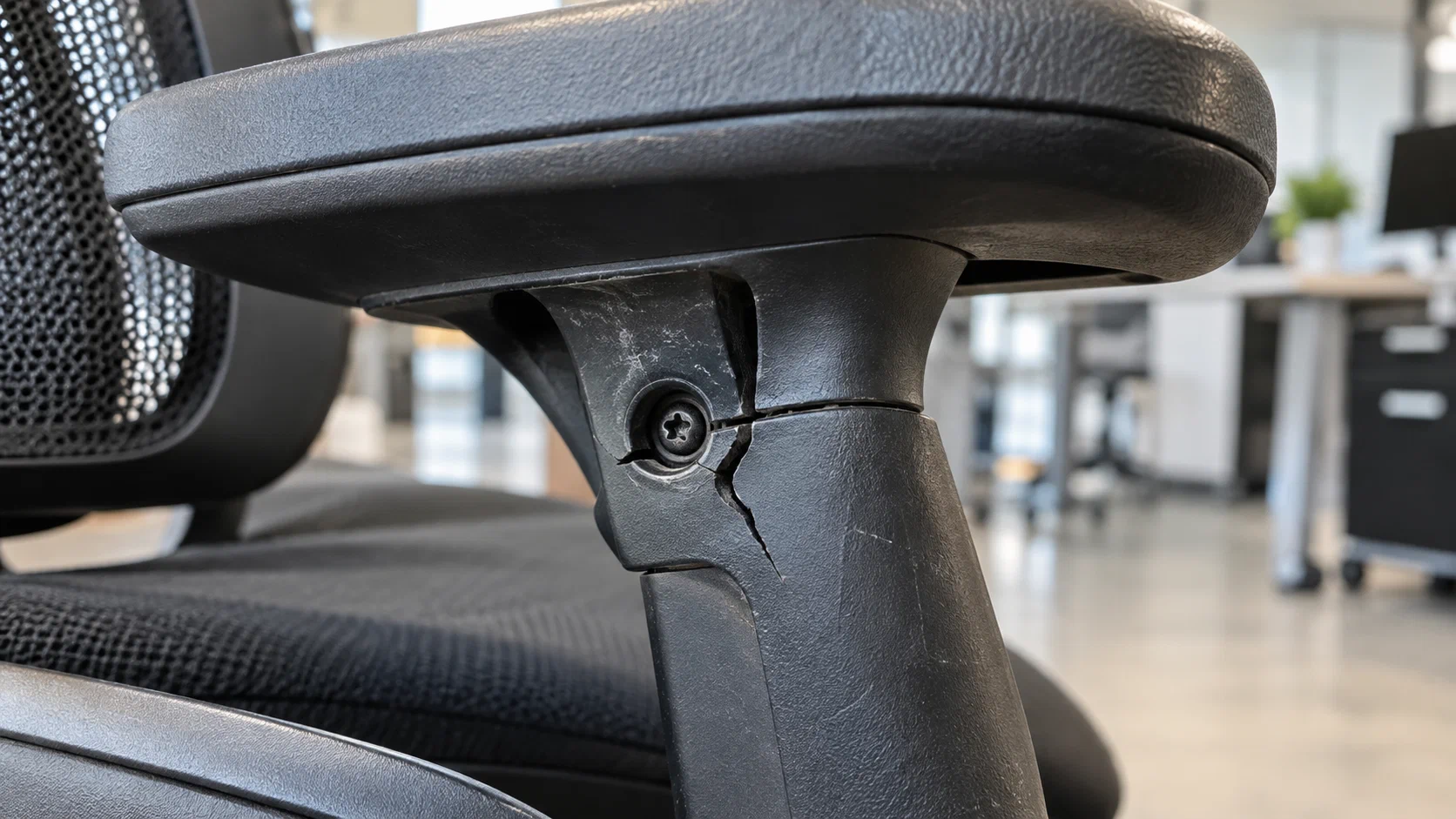
Ergonomic office chair armrests are subjected to repeated loads every day, from the weight of a user's arms to the force applied when leaning on them while standing up. Some chairs perform well when new but develop cracks around the lower mounting points after a period of use. The joints may gradually loosen, increasing warranty claims and replacement costs for chair manufacturers.
The problem is not always caused by insufficient material strength. Screw bosses, mounting holes, and sharp corners can concentrate stress in small areas. Poor wall thickness design, abrupt structural transitions, excessive screw-tightening force, weld lines, and residual stress from injection molding can all contribute to cracking. The cause should therefore be assessed by considering component geometry, assembly methods, and actual loading conditions rather than tensile strength alone.
Material selection also plays an important role. ABS offers good processability and surface appearance, making it suitable for many chair components with moderate structural requirements. For armrest supports that require greater stiffness and strength, glass-fiber-reinforced PA6 or PA66 may be worth evaluating. However, increasing glass-fiber content does not automatically prevent cracking. Although reinforcement can improve stiffness, it may also affect toughness, weld-line performance, and molding shrinkage. When a mounting area already contains significant stress concentrations, a toughened formulation may provide a better balance between strength and impact resistance than simply increasing reinforcement.
When an armrest cracks during assembly or fails after repeated loading, the material, mold, and molding conditions should be examined together. Wall thickness around the screw boss, rib layout, weld-line location, and packing conditions can all influence the finished component's performance. For these applications, TechInherit can evaluate engineering plastics and modification options based on the part structure and performance requirements, while considering mold design and injection molding factors that may contribute to cracking. This helps distinguish material limitations from structural or manufacturing problems instead of treating every failure as a simple lack of strength.
Reliable office chair components depend on the right combination of material properties, structural design, and manufacturing conditions. Selecting suitable ABS, PA6, PA66, or modified engineering plastics—and optimizing the mounting structure and molding process where necessary—can help reduce cracking around armrest joints, improve product durability, and lower long-term repair and replacement costs.
Request a Free Design Review
Looking to reduce the cost of your next plastic injection molding project? Contact our engineering team today for a free consultation.
