
Why Do Automotive Plastic Components Have Dimensional Problems Even When Their Heat Resistance Meets Requirements?
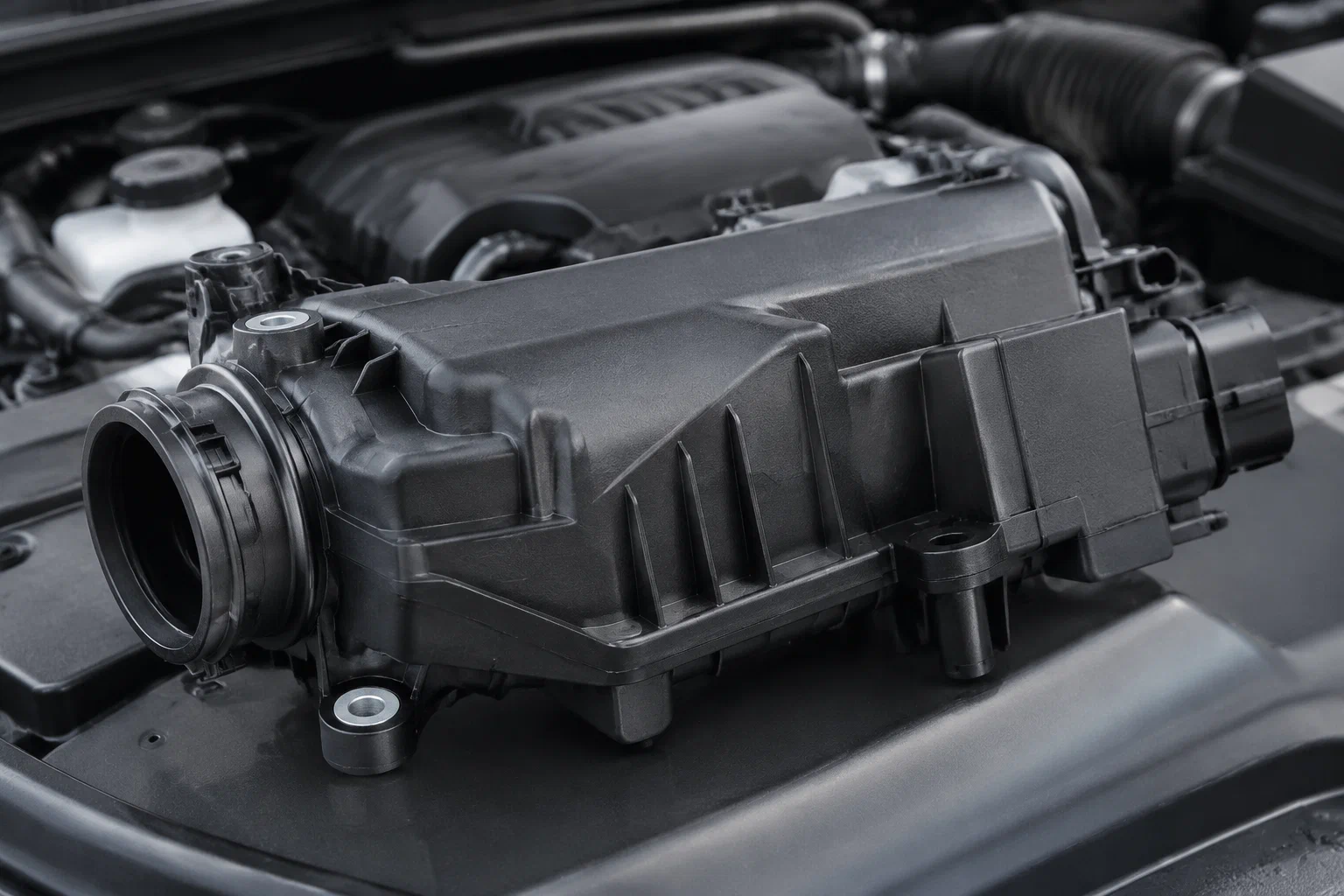
Plastic sensor housings, electrical connector components, and mounting brackets in automotive engine compartments are exposed to elevated temperatures, vibration, thermal cycling, and contact with oils or other chemicals. A component may meet its initial heat-resistance requirements in laboratory testing, yet develop loose snap-fits, connector alignment problems, or deformation around mounting points after being installed in a vehicle. For automotive component manufacturers, the issue is not necessarily insufficient heat resistance. It may instead involve dimensional stability, long-term loading behavior, and the interaction between the material and its actual operating environment.
Glass-fiber-reinforced PA66 and PBT are engineering plastics worth considering for automotive electrical and structural components. For example, some commercial PA66 GF30 grades have tensile strengths of approximately 150–200 MPa and heat deflection temperatures of around 240–260°C at 1.8 MPa. These are representative ranges, not guaranteed values for every grade. Heat deflection temperature is measured under specified short-term test conditions; it does not mean that a finished component can continuously carry a load at the same temperature. Long-term heat aging, sustained stress, humidity, and repeated temperature changes must also be considered.
Moisture absorption and glass-fiber orientation are two factors that can easily be overlooked. PA66 provides good mechanical strength, but moisture absorption can change its dimensions. During injection molding, glass fibers tend to align with the melt flow, creating different shrinkage behavior in different directions. Components with precision locating holes, snap-fits, or thin connecting sections may therefore develop localized dimensional deviations even when the material has high stiffness. PBT generally absorbs less moisture than PA66 and may be worth evaluating where dimensional stability and electrical performance are important. For more demanding thermal or chemical environments, higher-temperature materials may also need to be considered. The right choice depends on the actual operating conditions rather than a single performance value.
Consider a typical engineering scenario in which an automotive sensor housing passes its initial dimensional inspection but develops a fit deviation after repeated thermal cycling. Increasing the glass-fiber content may appear to be an easy way to improve stiffness, yet it can also change melt flow, shrinkage, and warpage. A more effective approach is to identify where and in which direction the deviation occurs, then examine moisture sensitivity, fiber orientation, local wall thickness, gate location, and cooling conditions. If the material is poorly matched to the environment, the formulation may need to be reassessed. If the deviation is concentrated in a particular area, mold design and injection molding conditions should be investigated rather than simply selecting a material with a higher heat-resistance rating.
For these automotive plastic components, TechInherit can evaluate engineering plastics such as PA66 GF30 and PBT against the application requirements, while considering material modification, dimensional stability, molding shrinkage, and mold design together. Compared with selecting a grade solely because it has the highest heat-resistance figure on a datasheet, evaluating the material and finished molded part as a system can help reduce the risk of persistent warpage or assembly deviations after a material upgrade. It may also prevent unnecessary tooling trials and repeated material changes.
After material selection, the proposed solution should be validated under conditions relevant to the application. Depending on the component, this may include heat aging, thermal cycling, dimensional measurements, and mechanical testing. Automotive components must also meet the specifications and validation requirements associated with their intended installation and service conditions. A single material property cannot establish production suitability. Reliable automotive plastic components must maintain the required dimensional accuracy and structural performance not only during initial testing, but also under long-term temperature variation and mechanical loading.
Request a Free Design Review
Looking to reduce the cost of your next plastic injection molding project? Contact our engineering team today for a free consultation.
