
Why Can Lightweight Robotic Grippers Lose Positioning Accuracy?
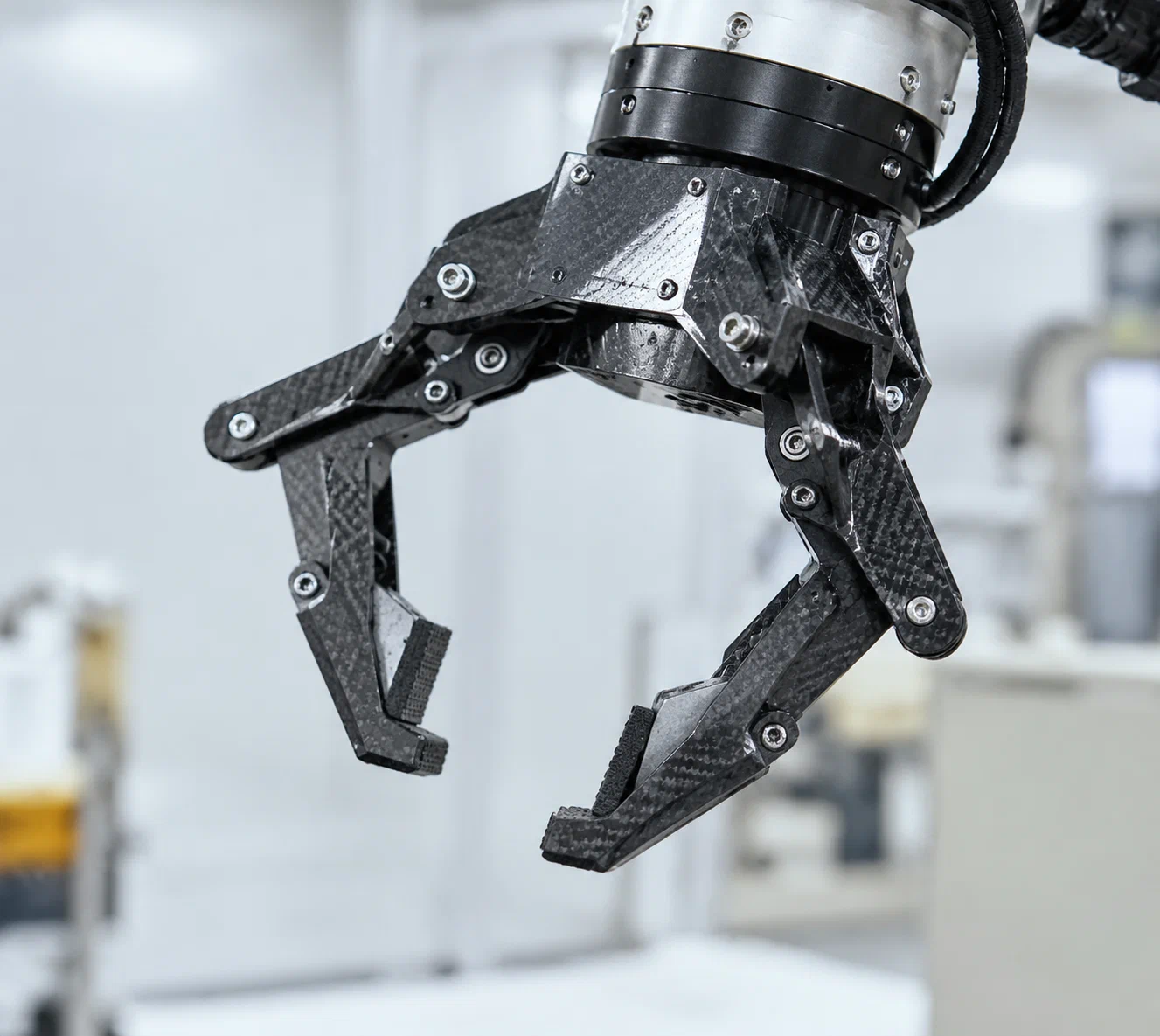
In high-speed pick-and-place operations, precision assembly, and automated material handling, the weight of a robotic end effector directly affects the available payload and moving inertia of the robot arm. Traditional aluminum grippers offer good stiffness and machining accuracy, but excessive tooling weight places additional demands on the drive system during repeated acceleration and deceleration. To reduce this load, some robotics manufacturers are replacing selected aluminum mounting brackets, gripper supports, and structural components with carbon-fiber-reinforced engineering plastics. However, a lighter component does not automatically provide better performance. Some plastic grippers perform well during initial static testing but develop vibration, positioning deviations, or mounting instability during high-speed operation.
Carbon-fiber-reinforced PA6 and PA66 offer useful properties for these applications. Compared with unreinforced nylon, carbon fiber reinforcement can significantly improve stiffness, strength, and dimensional stability. For example, certain commercial PA66 CF30 grades have a dry-state tensile modulus of approximately 20,000 MPa, tensile strength around 200 MPa, and density near 1.28 g/cm³. Although their absolute stiffness remains lower than that of aluminum alloys, their lower density creates opportunities for reducing component weight. These values are representative of specific commercial formulations rather than guaranteed properties for all carbon-fiber-reinforced plastics, and they cannot directly predict the load capacity of a finished gripper.
The greater challenge is translating material properties into reliable injection-molded components. Robotic gripper brackets often contain mounting holes, reinforcing ribs, locating surfaces, and complex connecting features. Carbon fiber orientation during molding can influence stiffness and shrinkage in different directions. If the primary loading direction is poorly matched to the reinforcement orientation, localized deformation may occur. Even when this deformation is too small to cause visible damage, it can affect gripping positions and repeatability in precision automation. Moisture absorption in PA6 and PA66, creep under sustained loading, and concentrated stress around screw connections must also be considered during product development.
Consider a typical engineering scenario involving a manufacturer replacing an aluminum robotic gripper bracket with carbon-fiber-reinforced plastic. The first prototype achieves a noticeable weight reduction, but during continuous high-speed handling tests, slight movement develops around the mounting area. Simply increasing carbon fiber content may raise material costs and processing difficulty without eliminating the problem. The mounting geometry, local wall thickness, fiber orientation, and long-term loading conditions need to be examined first. Depending on the failure mechanism, metal inserts at critical fastening points or changes to the reinforcing rib structure may provide a more effective improvement than increasing material stiffness alone.
For lightweight structural components such as robotic gripper supports, this is where TechInherit's combination of engineering plastic modification and injection molding becomes valuable. Carbon-fiber-reinforced PA6, PA66, and other suitable materials can be evaluated according to the actual loads, dimensional requirements, and part geometry, while mold flow, fiber distribution, and molding conditions are considered during development. Instead of determining metal replacement feasibility from a material datasheet alone, the finished molded component needs to demonstrate adequate structural performance under real operating conditions. Where a glass-fiber-reinforced formulation already meets the requirements, moving to a more expensive carbon fiber material may offer little practical benefit.
The value of lightweight robotic components must ultimately be demonstrated through application testing. Beyond comparing mass and static strength, manufacturers should evaluate deformation, positioning repeatability, fastener stability, and dimensional changes under defined loads and operating cycles. For robotic parts intended for mass production, matching the reinforcement system, component design, and injection molding process to the actual application is often more valuable than simply maximizing material strength. The objective is to achieve reliable performance with a suitable balance of weight, manufacturing consistency, and total component cost.
Request a Free Design Review
Looking to reduce the cost of your next plastic injection molding project? Contact our engineering team today for a free consultation.
