
Why Can Solar Inverter Plastic Components Still Face Insulation Risks After Meeting Flame-Retardant Requirements?
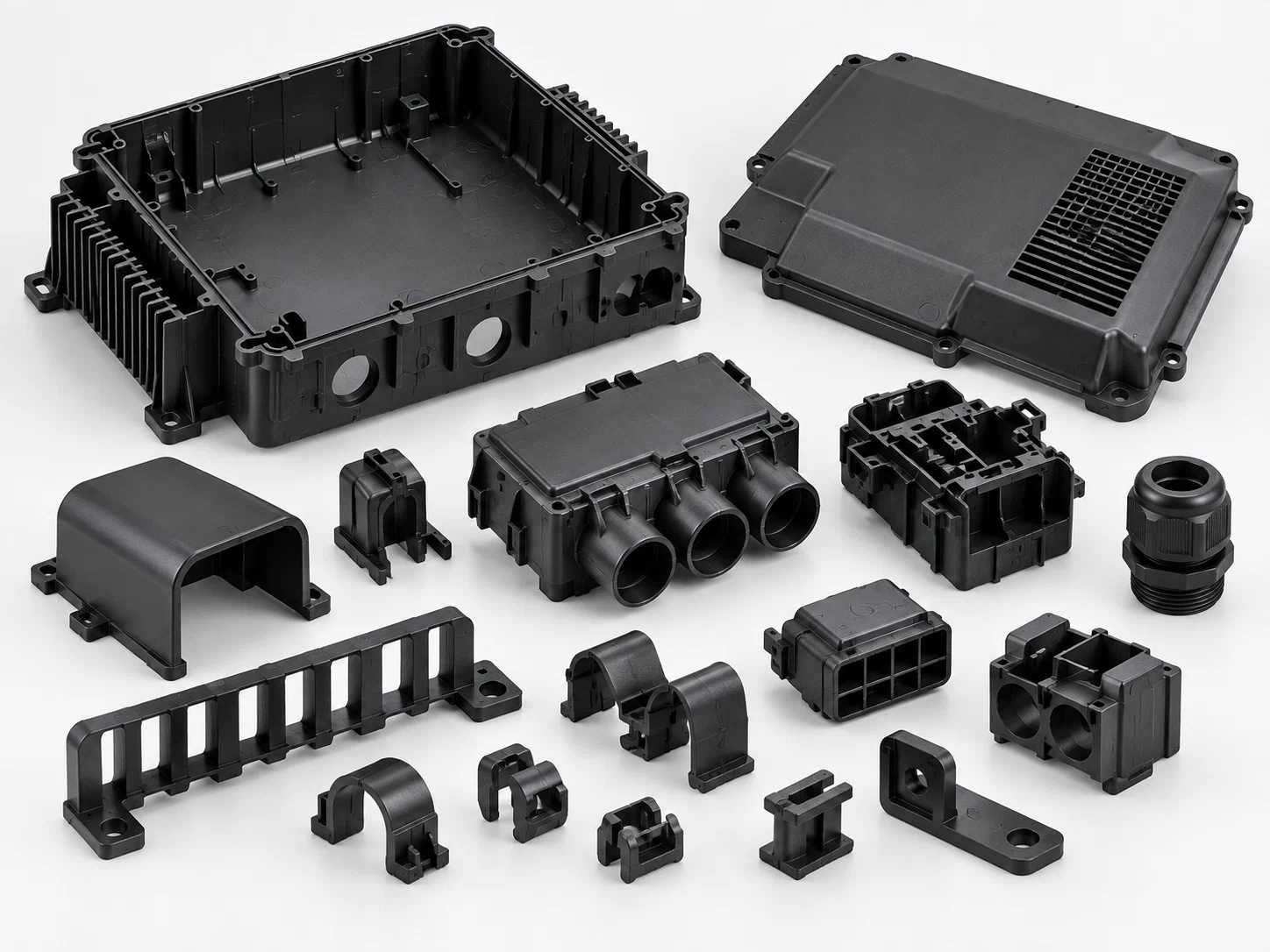
Solar inverters contain numerous injection-molded plastic components used to support, secure, and insulate electrical assemblies, including DC input terminal supports, insulating brackets, connector housings, and internal structural parts. These components must withstand mechanical loads, heat generated during operation, electrical stress, and changes in environmental humidity. Flame retardancy is an important consideration during material selection, but meeting a specified flammability rating does not automatically mean that a plastic provides all the electrical insulation properties required for the application.
Flame-retardant PA66 and PBT are engineering plastics commonly considered for electrical components. Certain commercial grades can achieve UL94 V-0 at specified test thicknesses, such as 1.5 mm, depending on their formulation and certified properties. However, UL94 primarily evaluates material flammability under defined test conditions. It does not directly establish resistance to electrical tracking. When insulating surfaces are exposed to electrical stress, moisture, and contamination over time, conductive paths may develop along the plastic surface, increasing the risk of leakage current and insulation failure. Components such as terminal supports therefore require attention not only to flame retardancy but also to comparative tracking index (CTI) and creepage distance.
CTI is an important property used to compare the tracking resistance of solid insulating materials. According to IEC 60112, materials are evaluated under defined electrical and contamination conditions. In the material classification system used by IEC 60664-1, a CTI of at least 400 V corresponds to Material Group II, while a CTI of 600 V corresponds to Material Group I. These figures are material classification values, not the rated operating voltage of a finished electrical component. For solar inverter applications, insulation design must also account for the actual working voltage, pollution degree, creepage distance, and relevant product safety requirements.
When a solar inverter terminal support must provide flame retardancy, mechanical strength, and high tracking resistance at the same time, selecting a conventional glass-fiber-reinforced plastic may not be sufficient. PA66 GF30 can offer high stiffness and strength, but its flame-retardant performance and CTI depend on the complete material formulation rather than the 30% glass-fiber content alone. PBT generally absorbs less moisture than PA66 and may be suitable for certain components requiring dimensional stability and electrical performance. However, resistance to hydrolysis under prolonged hot and humid conditions must also be evaluated for the specific grade. Neither material should be selected solely on the basis of one test value.
The challenge becomes more complex when several performance requirements must be achieved simultaneously. Modifying a flame-retardant system can influence electrical tracking resistance, while reinforcement selection may affect flowability, toughness, and molding shrinkage. This is where TechInherit's experience with flame-retardant engineering plastic modification and injection molding can provide practical value. Material formulations can be evaluated against the required mechanical, thermal, flame-retardant, and electrical properties while considering the geometry of the finished component. For terminal supports and insulating brackets with thin walls, ribs, and mounting features, mold filling, fiber orientation, and dimensional accuracy also need attention. A material that performs well in standard tests must still be suitable for manufacturing the actual part.
Once a candidate material is selected, validation should cover the required flammability, tracking resistance, heat-aging, and mechanical properties, together with the electrical clearances and creepage distances of the finished assembly. For solar power equipment designed for long-term operation, material performance alone is not enough to establish reliability. The actual temperature, humidity, electrical environment, and applicable equipment standards must also be considered. Addressing material formulation, insulation requirements, and injection molding during product development can help manufacturers avoid repeated material changes, unnecessary tooling modifications, and preventable reliability problems.
Request a Free Design Review
Looking to reduce the cost of your next plastic injection molding project? Contact our engineering team today for a free consultation.
