
Why Do Power Tool Battery Latches Become Loose Over Time? High Strength Does Not Guarantee Durability
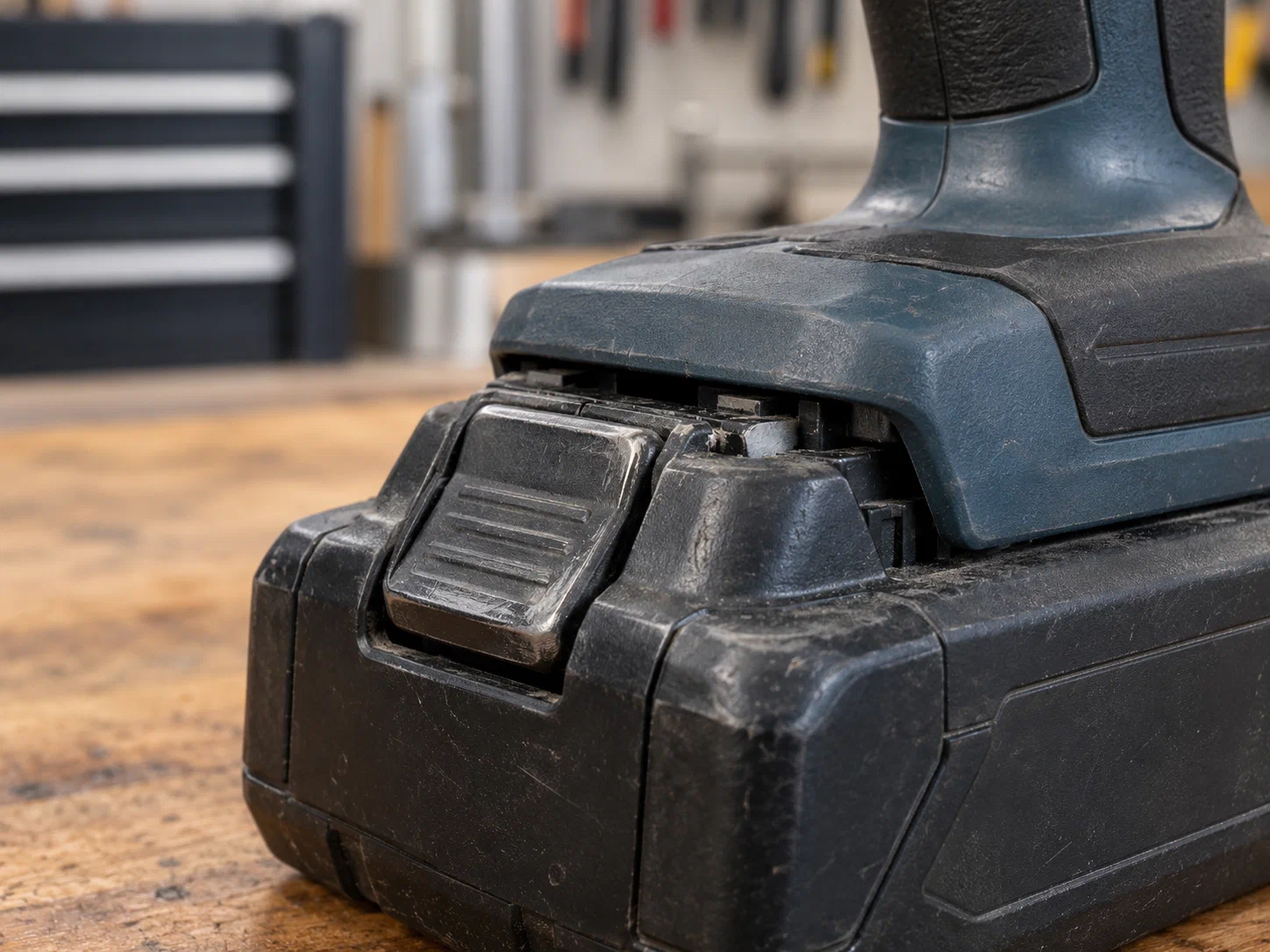
Cordless drills, impact wrenches, and other portable power tools may undergo repeated battery insertion and removal throughout their service life. The plastic latch at the battery interface must flex during installation and recover its shape to maintain a secure connection. When the latch gradually loses its locking force, the battery may become loose or move during tool operation. This is not necessarily just an assembly-clearance problem; it may involve material toughness, long-term creep, and component geometry. Repeatedly replacing the latch or tightening the assembly may provide temporary relief, but identifying why the locking force decreases is more useful for a long-term solution.
PA6 and PA66 are common engineering plastics for power tool components. Unreinforced nylon offers useful toughness, while glass-fiber reinforcement can improve stiffness and dimensional stability. For example, a commercially available BASF PA66 GF30 grade has a dry tensile modulus of approximately 10,000 MPa and tensile strength of around 190 MPa, but its strain at break is only about 3.6%. These figures illustrate an important trade-off: glass-fiber-reinforced nylon can carry substantial loads, but that does not make it suitable for every repeatedly flexing feature. A battery latch requiring significant elastic movement may become more vulnerable to cracking if stiffness is prioritized without considering toughness. Conversely, a material that undergoes excessive creep under sustained stress may gradually lose its locking force without actually breaking.
Consider a typical power tool development scenario in which a battery latch becomes loose after repeated insertion and removal, even though no obvious cracks are visible. Replacing the existing material with a higher-glass-fiber-content PA66 grade may not solve the problem. The first step is to distinguish between different failure mechanisms. Whitening or fine cracks near the latch root may indicate stress concentration, insufficient toughness, or a weld line formed during molding. If the latch remains intact but no longer returns to its original position, creep, latch deflection, and mating clearances should be investigated. Comparing insertion-cycle performance across material options under the same structural and test conditions is more informative than comparing tensile strength values alone.
Material selection must also account for the entire battery interface. Moisture absorption in PA6 and PA66, fiber orientation in reinforced grades, molding shrinkage, and local stress around fastening points can all affect assembly performance. If the main housing requires high stiffness while the latch must flex repeatedly, reinforced and toughened formulations can be evaluated for their respective functions. The design may also need adjustments to the latch dimensions, root radius, or rib layout. In custom injection-molded components, material formulation and mold design are closely connected. Changing the resin without addressing local stress concentration can leave the original failure mechanism unchanged, even when the replacement material is more expensive.
For engineering plastic modification and custom injection molding, the important question is not simply how to increase the material grade, but how to match material behavior to the actual loading conditions. Evaluating PA6, PA66, and suitable reinforced or toughened formulations alongside latch geometry, molding conditions, and finished-part testing can help improve locking reliability. For power tool manufacturers, this approach offers a way to reduce repeated material trials, tooling changes, and replacement costs instead of continually increasing material expenditure after failures occur.
Ultimately, battery-interface reliability must be demonstrated in the finished component. In addition to initial insertion force, testing should examine locking-force retention after defined insertion cycles, cracking around the latch, dimensional changes with temperature, and stability during continued use. Combining material properties with durability testing on the actual component provides a more reliable basis for selection than relying on a single high-strength figure.
Request a Free Design Review
Looking to reduce the cost of your next plastic injection molding project? Contact our engineering team today for a free consultation.
