
Why Can Plastic Components in Data Center Liquid Cooling Connections Leak After Installation?
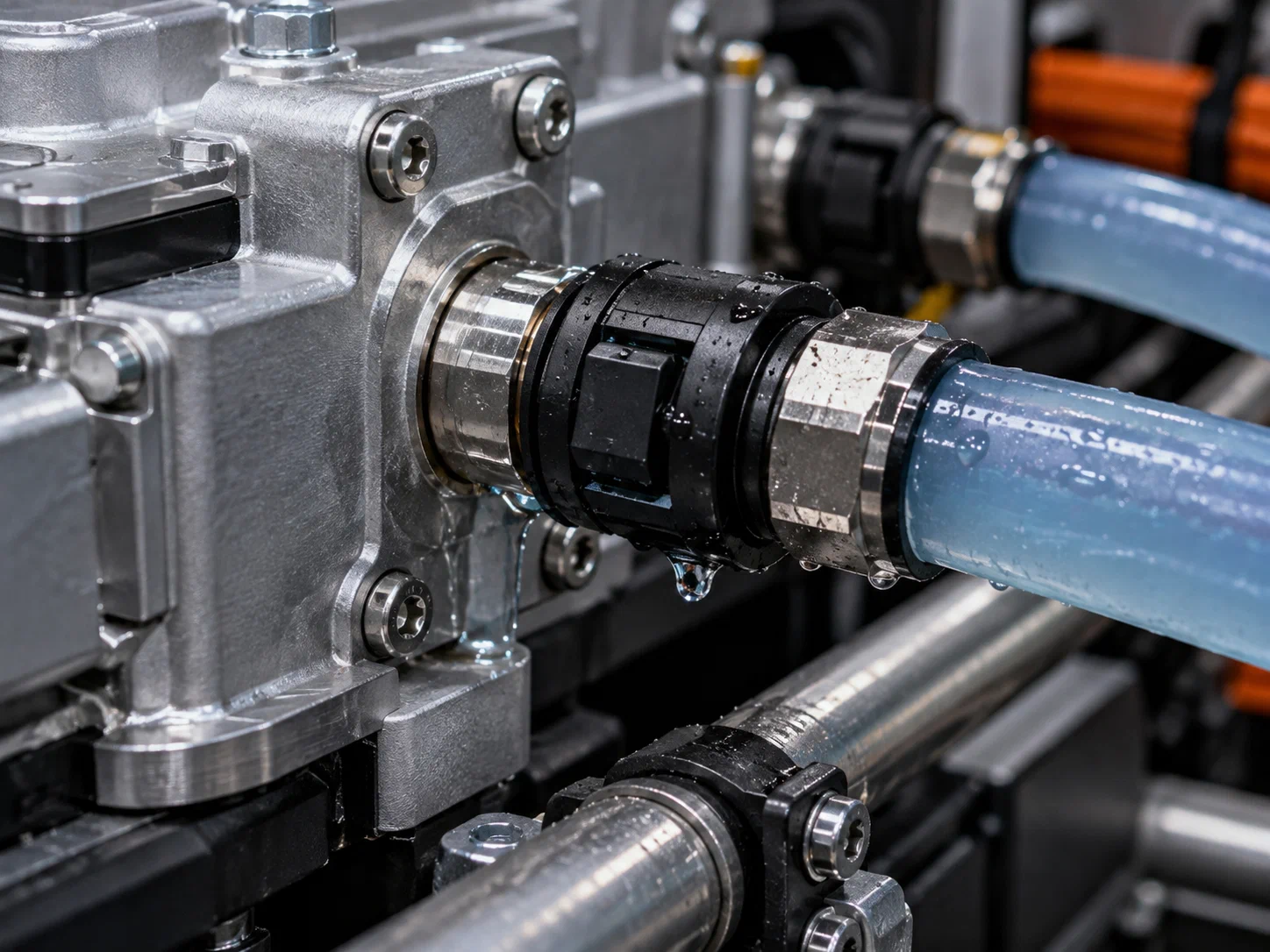
In data center liquid cooling systems, plastic connector components, valve guides, sealing supports, and coolant distribution parts must maintain reliable dimensional accuracy and sealing performance during long-term operation. As server workloads change, coolant temperature and system pressure may also fluctuate. Some plastic components pass initial leak tests but begin to develop minor leakage around connection points after prolonged operation or repeated thermal cycling. For liquid cooling equipment manufacturers, these failures can increase maintenance costs and create potential risks for servers and nearby electronic equipment.
Leakage is not always caused by insufficient initial material strength. In many cases, the problem involves dimensional or mechanical changes under the combined effects of temperature, pressure, and coolant exposure. For plastic components supporting an elastomeric seal, even a small amount of deformation can change seal compression and contact pressure. Long-term assembly loads may also cause creep or stress relaxation. If the sealing surface gradually shifts or local contact pressure decreases, a connector that initially passed inspection may begin leaking during service. Material selection should therefore consider long-term stiffness, dimensional stability, and fluid compatibility rather than tensile strength alone.
PA66 GF30 and glass-fiber-reinforced PBT are potential engineering plastic options for selected structural components. PA66 GF30 offers high mechanical strength and stiffness, although its moisture absorption and long-term behavior in contact with the selected coolant must be evaluated. PBT generally absorbs less moisture and can offer advantages for components requiring dimensional consistency. For example, one commercial BASF PBT GF30 grade has a typical molding shrinkage of approximately 0.3% parallel to the melt-flow direction and 1.1% perpendicular to it. This difference demonstrates that glass-fiber reinforcement does not eliminate directional shrinkage. For injection-molded components containing sealing grooves, locating holes, and precision mating surfaces, fiber orientation and shrinkage control can directly influence assembly accuracy. These values represent a specific commercial grade under defined test conditions, not universal properties of PBT GF30.
However, low moisture absorption does not automatically make PBT suitable for prolonged exposure to hot water or glycol-based coolants. Polyester materials can be susceptible to hydrolysis under certain temperature and moisture conditions, making hydrolysis-resistant grades worth evaluating where appropriate. The coolant formulation, operating temperature, exposure duration, and retention of mechanical properties after aging must all be considered. Additives such as corrosion inhibitors may also influence compatibility with plastics and elastomeric sealing materials. Selecting a polymer solely from room-temperature datasheet values can overlook important long-term operating risks.
For a liquid cooling connector that has already been designed, material formulation and injection molding accuracy should be evaluated together. Increasing reinforcement to improve stiffness may introduce additional challenges if fiber orientation and molding shrinkage are not properly controlled, particularly around precision sealing grooves. On the other hand, modifying the mold without addressing long-term creep or coolant compatibility may improve initial sealing performance without preventing later failures. This is where TechInherit's material modification, mold development, and injection molding capabilities become relevant to custom plastic components. Rather than automatically selecting a more expensive engineering plastic, the material and manufacturing process can be evaluated according to sealing loads, operating temperatures, fluid exposure, and the required dimensional tolerances.
For liquid cooling equipment manufacturers, sealing reliability must ultimately be demonstrated on the finished assembly. In addition to initial leak testing, validation may need to include pressure retention, thermal cycling, long-term fluid exposure, and dimensional inspection under assembled conditions. If leakage appears only after thermal cycling, sealing groove dimensions, O-ring compression, and deformation of the plastic support should be examined. If cracking or mechanical deterioration is also observed, material compatibility with the coolant becomes an important part of the investigation. Identifying the actual failure mechanism is often more effective than repeatedly changing materials or increasing initial sealing pressure, especially when the objective is to reduce maintenance, rework, and long-term operating costs.
Request a Free Design Review
Looking to reduce the cost of your next plastic injection molding project? Contact our engineering team today for a free consultation.
