
Structural Reliability of Ergonomic Chair Bases: Benefits and Design Limits of PA66 GF30
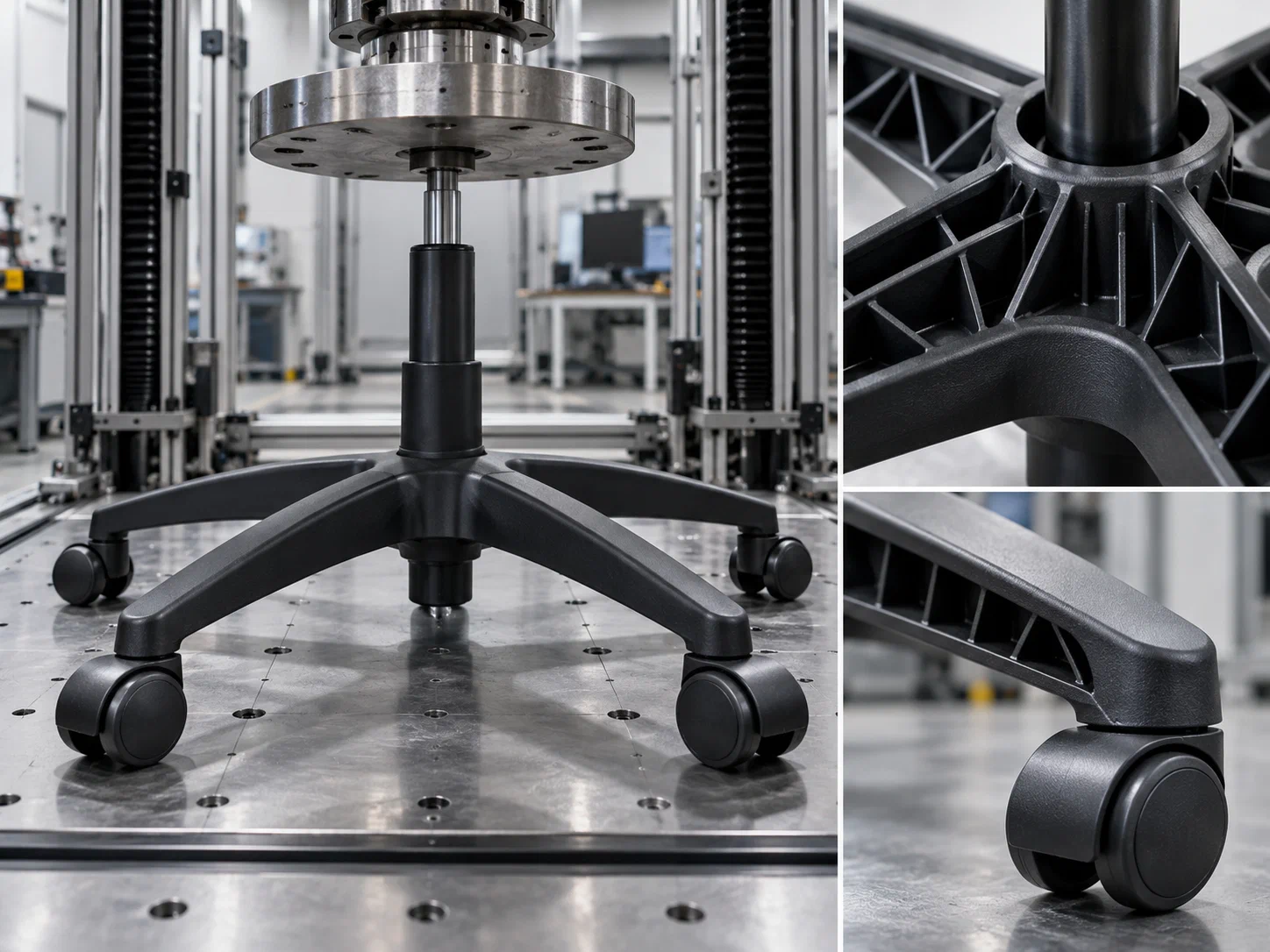
The five-star base of an ergonomic office chair must withstand static loads from the user, impact during chair movement, and repeated mechanical stress throughout everyday use. Passing an initial load test does not automatically guarantee long-term reliability. Cracks around the spoke roots, deformation of the central hub, or looseness around caster sockets may result from a combination of material properties, component geometry, and injection molding quality. For office chair manufacturers, the objective is not simply to achieve a high peak load during testing, but to maintain structural integrity and dimensional stability throughout the product's service life.
PA6 and PA66 are engineering plastics worth evaluating for chair bases and other load-bearing furniture components. Unreinforced nylon offers useful toughness and impact resistance, while glass-fiber reinforcement can significantly improve stiffness and reduce deformation under load. As one commercial example, ALTECH PA66 A 2030/109 GF30 has a dry tensile strength of approximately 180 MPa and a tensile modulus of around 10,000 MPa. In the conditioned state, the corresponding values are approximately 110 MPa and 6,400 MPa. Its heat deflection temperature at 1.8 MPa is about 250°C. <Cite refs={["turn812342search12"]}/> These values illustrate the stiffness available from glass-fiber-reinforced PA66, while also showing that moisture conditioning can influence measured properties. However, heat deflection temperature is not the permissible service temperature of a chair base, and tensile strength alone cannot determine the load capacity of the complete component.
The design challenge is that loads are not distributed evenly across a five-star base. The central hub, spoke roots, and caster sockets experience different stress conditions. Excessive wall-thickness transitions, poorly positioned ribs, or stress concentrations around the spoke roots can contribute to cracking even when a high-stiffness PA66 GF30 grade is used. Increasing glass-fiber content may improve stiffness, but it can also change melt flow and directional shrinkage. For some PA66 GF30 grades, shrinkage parallel to the flow direction differs noticeably from shrinkage perpendicular to it. In a large molded chair base, these differences may contribute to spoke warpage or caster socket misalignment, affecting assembly consistency and smooth movement. <Cite refs={["turn812342search12","turn812342search14"]}/>
Material selection must also reflect the actual loads and operating environment. PA66 GF30 is worth considering for structures requiring high stiffness, but not every chair base needs the same reinforcement system. Products exposed to low temperatures, repeated movement impacts, or relatively thin spoke sections may require closer evaluation of impact toughness, notch sensitivity, and the performance of the finished molded component. Depending on the design, another reinforcement level or a toughened nylon formulation may be more appropriate than simply increasing glass-fiber content. The aim is to balance stiffness, impact resistance, dimensional stability, and material cost according to the product's requirements.
For custom injection-molded chair bases, tooling and processing conditions also influence the final result. Fiber orientation during mold filling, gate location, packing conditions, and cooling uniformity can affect shrinkage and residual stress around the spokes. If initial trials focus only on appearance and basic dimensions, potential weaknesses around the spoke roots, central hub, and caster sockets may remain undetected until mass production. TechInherit's work in engineering plastic modification, mold development, and injection molding is relevant here because these factors can be evaluated together, matching the material formulation to the component geometry and manufacturing conditions rather than selecting a grade solely because it has a higher strength value.
For office chair manufacturers, structural reliability must ultimately be demonstrated through finished-part validation. In addition to the required static load tests, the product may need evaluation for movement impact, repeated loading, caster socket stability, and structural changes after extended use. Considering material properties, spoke geometry, mold design, and finished-component testing together provides a more reliable basis for material selection. Compared with simply pursuing higher material strength, this approach can help reduce repeated tooling trials, material changes, and after-sales repair costs.
Request a Free Design Review
Looking to reduce the cost of your next plastic injection molding project? Contact our engineering team today for a free consultation.
