
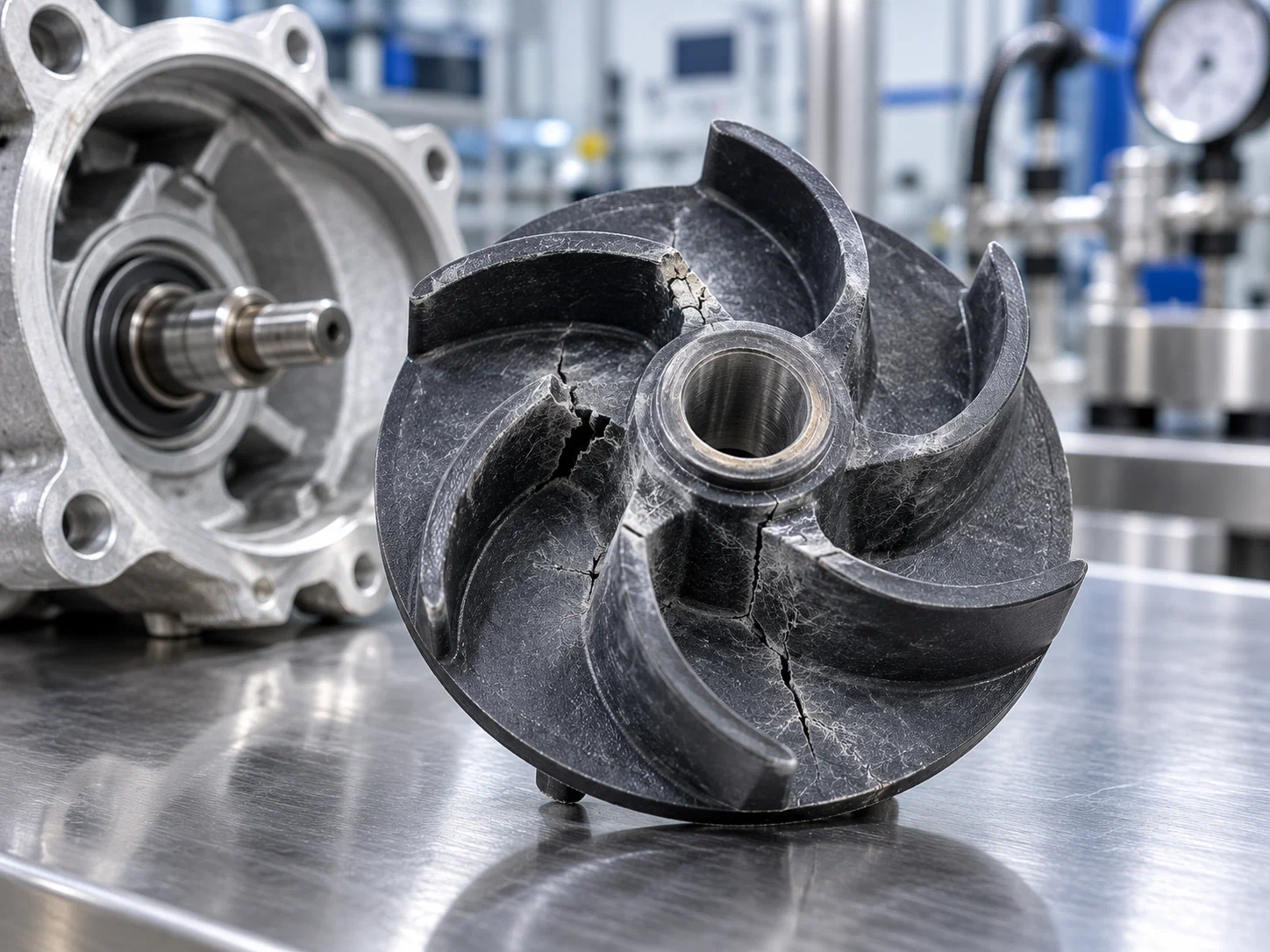
Plastic impellers in automotive engine cooling systems must rotate at high speed while remaining exposed to coolant, temperature fluctuations, centrifugal loads, and sustained mechanical stress. A component may show good initial stiffness and strength but gradually become brittle after prolonged operation, eventually developing cracked blades or damage around the hub. For automotive component manufacturers, these failures cannot be addressed simply by selecting a material with higher initial strength. Long-term coolant exposure can change polymer performance, while impeller geometry and injection molding quality also influence service life.
PA66 GF30 is an engineering plastic worth evaluating for automotive cooling components. Reinforcement with 30% glass fiber improves stiffness and mechanical strength, making it suitable for selected structural parts exposed to sustained loads. One automotive water-pump technical reference reports a tensile stress at break of approximately 175 MPa, flexural strength of around 280 MPa, and heat deflection temperature of about 250°C for a particular PA66 GF30 grade. These values describe performance under specified test conditions; they do not directly predict long-term behavior in hot coolant. Heat deflection temperature, in particular, should not be treated as a continuous service-temperature rating or a direct measure of impeller life.
One easily overlooked factor is coolant aging. During prolonged exposure to hot water and glycol-based coolant mixtures, PA66 may undergo hydrolysis, causing polymer-chain degradation and a reduction in toughness and mechanical performance. A technical reference examining one specific PA66 GF30 formulation reported that its tensile stress at break decreased from approximately 175 MPa to 32 MPa after 42 days of forced aging in coolant at 130°C. This result applies only to the formulation and test conditions in that study, not to every PA66 GF30 grade. Nevertheless, it illustrates why high initial dry-state strength does not guarantee equivalent performance after long-term coolant exposure.
When an impeller develops cracked blades or hub damage, material aging is only one part of the investigation. Blade thickness, root radii, the connection between the hub and shaft, and the distribution of loads during high-speed rotation can all contribute to stress concentration. Increasing glass-fiber content may improve stiffness, but it can also alter melt flow, fiber orientation, and molding shrinkage, potentially increasing brittleness in certain thin sections. For components exposed to hot coolant over extended periods, hydrolysis resistance, retained toughness after aging, and fatigue performance may be more important than maximizing initial tensile strength alone.
Hydrolysis-stabilized PA66 GF30 can be evaluated as a candidate material, provided that it is validated against the actual coolant formulation, operating temperature, and service-life requirements. Where temperatures are higher or long-term property retention is especially demanding, reinforced PPA or PPS grades suitable for the application may also be considered. These materials are not interchangeable universal solutions: their mechanical properties, processing windows, costs, and compatibility with the operating fluid must be evaluated for the specific component.
The development of a custom injection-molded impeller must go beyond material datasheets. Gate location, melt flow, glass-fiber orientation, blade thickness, and cooling uniformity can all affect the structural integrity of the finished component. Material formulation, impeller geometry, mold development, and injection molding conditions need to be evaluated together to avoid premature failure caused by localized stress or molding defects. For specialty engineering plastic components, this integrated approach can also reduce unnecessary material trials and tooling modifications.
Ultimately, automotive coolant pump impellers must be validated under conditions representative of their intended service. In addition to initial mechanical properties, testing should assess strength and toughness after coolant aging, dimensional changes following thermal cycling, and durability at the specified rotational speed and load. A suitable material is not simply one that delivers high strength during initial inspection, but one that continues to meet the component's performance requirements under prolonged exposure to hot fluids and mechanical stress.
Request a Free Design Review
Looking to reduce the cost of your next plastic injection molding project? Contact our engineering team today for a free consultation.
