
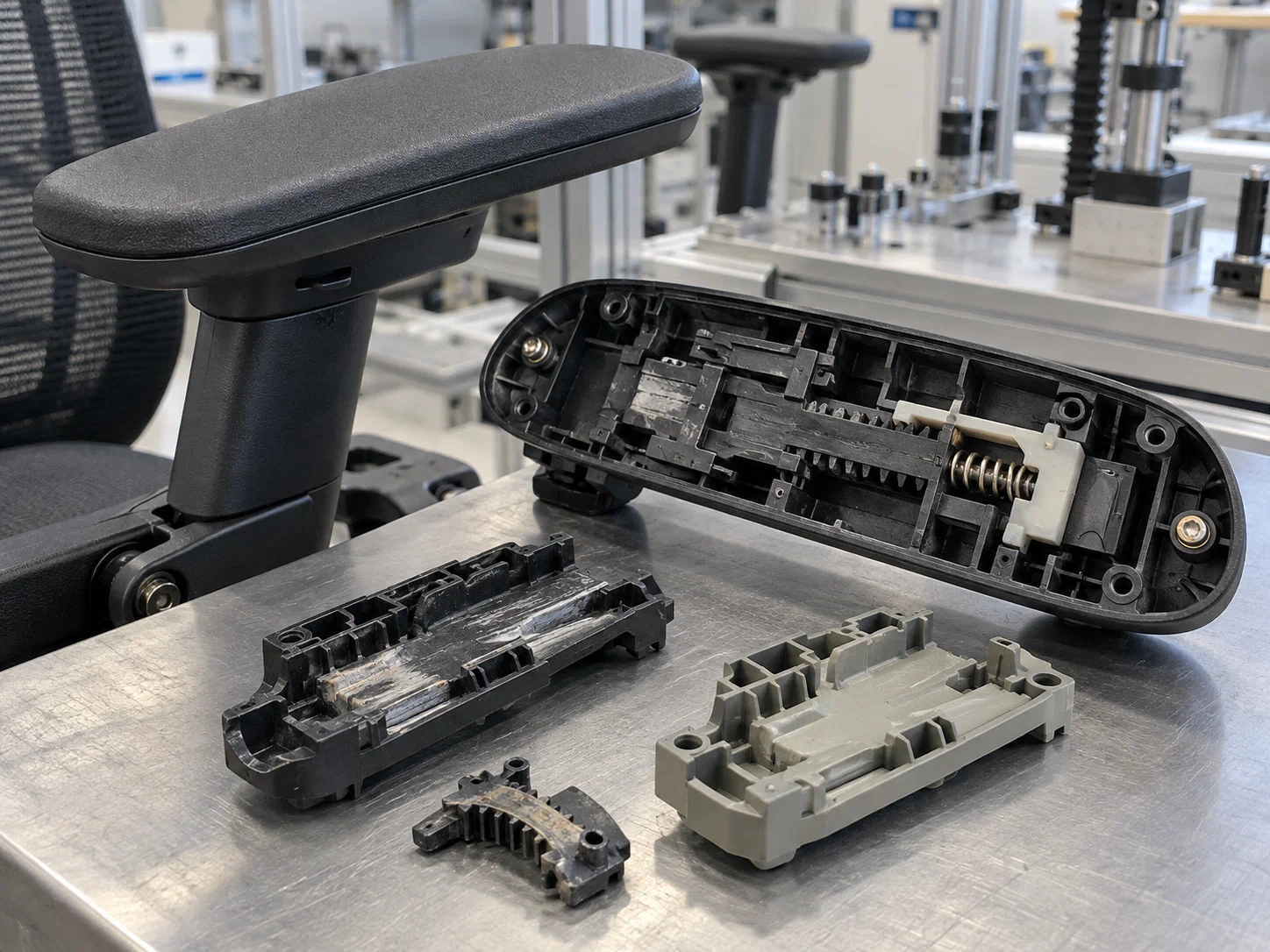
Multi-directional armrests in ergonomic office chairs undergo repeated adjustment throughout their service life. Each time a user changes the height, forward position, or angle, internal sliders, guides, and supporting structures experience different types of loading. A new chair may operate smoothly, yet after extended use, the mechanism may develop increased friction, inconsistent movement, noise, or excessive play. These symptoms may appear to be simple wear of plastic components, but they can also result from deformation, changes in assembly clearance, or dimensional variation during injection molding. For office chair manufacturers, tightening the clearance may make adjustment more difficult, while replacing a single slider may not resolve the long-term stability of the entire mechanism.
Nylon is not limited to load-bearing brackets. With suitable modification, PA6 and PA66 can also be evaluated for plastic components that experience repeated contact and relative sliding. For internal armrest sliders and guide components, wear-modified nylon may be considered according to contact pressure, movement speed, and operating frequency. Supporting arms and mounting brackets that carry lateral loads may benefit from glass-fiber-reinforced PA6 or PA66. These components have different priorities: sliders require attention to wear, friction, and operating feel, while supports must maintain stiffness, resist deformation, and preserve assembly stability. Maximizing stiffness across every component does not necessarily produce a better adjustment mechanism. Likewise, a wear-resistant slider cannot compensate for a support structure that gradually deforms.
BASF's published data for Ultramid B3EG6 provides one example of a 30% glass-fiber-reinforced PA6 injection molding grade. Its tensile modulus is approximately 9,500 MPa and tensile stress at break is around 185 MPa in the dry state. Under conditioned conditions, the corresponding values are approximately 6,200 MPa and 115 MPa. Its equilibrium moisture absorption at 23°C and 50% relative humidity is approximately 2.1%, increasing to around 6.6% at saturation in water. These figures illustrate the stiffness available from reinforced nylon, while also showing that material conditioning can affect mechanical properties and dimensions. They apply to this specific commercial grade, not to every PA6 GF30 formulation, and they do not establish the wear life of a sliding component.
Consider a multi-directional armrest that gradually becomes difficult to move forward and backward while also developing noticeable looseness. Replacing the slider with a more wear-resistant nylon may improve surface durability but will not correct clearance changes caused by deformation of the supporting bracket. Reducing the sliding clearance may remove some looseness, yet cause binding when dimensional variation or temperature changes are taken into account. A more effective investigation begins by examining wear locations and surface conditions, followed by checks of support deformation, guide alignment, mating clearances, and operating force after assembly. Only then should the design team decide whether to modify the wear-resistant formulation, reinforcement level, local geometry, or mold dimensions, rather than repeatedly changing materials without identifying the actual failure mechanism.
For custom injection-molded components, material selection must also be coordinated with tooling and processing. Fiber orientation in reinforced nylon, directional shrinkage, local wall thickness, and cooling conditions can affect the flatness and assembly accuracy of supporting components. Wear-modified nylon also needs validation in the actual part; the material designation alone cannot guarantee better durability. TechInherit's engineering plastic modification, mold development, and custom injection molding capabilities are relevant to evaluating material formulations, component geometry, and molding accuracy according to the different requirements of sliders and support structures. The objective is not simply to select a higher material grade, but to achieve a practical balance between smooth adjustment, structural stability, and consistency in mass production.
The durability of an armrest mechanism must ultimately be demonstrated through repeated adjustment testing of the finished assembly. In addition to initial operating force, validation should examine wear, changes in adjustment resistance, clearance variation, noise, and deformation of the supporting components after repeated cycles. For production projects, alternative material and design options should be compared under consistent test conditions, while dimensional consistency of the molded components is monitored. Evaluating wear-modified nylon, reinforced nylon, component clearances, and molding quality together provides a more effective way to reduce binding, looseness, and repeated production rework.
Request a Free Design Review
Looking to reduce the cost of your next plastic injection molding project? Contact our engineering team today for a free consultation.
