
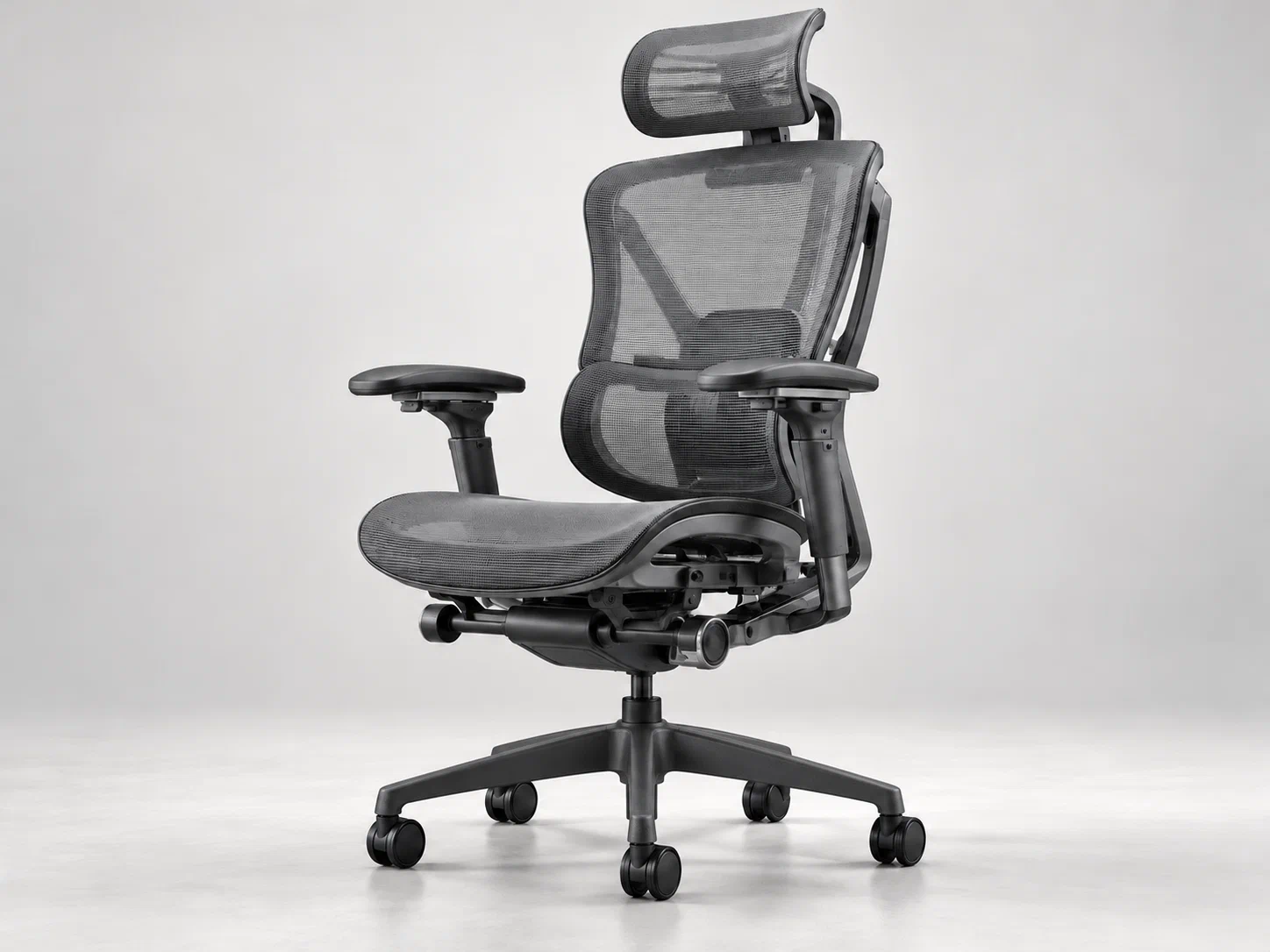
Adjustability is receiving greater attention in the latest ergonomic chair designs, particularly in armrests, backrests and headrests. On October 16, Singapore-based office furniture brand INTERDESK introduced its InterGlide X5 ergonomic chair, featuring 6D adjustable armrests, a 4D headrest, multi-level lumbar support and a recline angle of up to 160 degrees. According to the company, the lumbar support provides 12 height settings and five depth adjustments, while the armrests allow positioning in several directions. Meanwhile, ORGATEC 2026, scheduled for October 27–30 in Cologne, Germany, will bring together manufacturers presenting new seating and workplace solutions. Beyond comfort and appearance, these developments also raise practical questions about the structural components required to support increasingly sophisticated adjustment mechanisms.
Adding more adjustment features generally means greater complexity inside the chair. Armrests must remain stable in different positions, backrest structures need to withstand repeated loading, and headrest connections must provide smooth adjustment without losing positioning reliability. These functions depend on a combination of molded housings, support frames, sliding elements, connectors and other components. Although some parts are relatively small, dimensional variation, deformation or wear can affect the performance of the entire mechanism. For seating manufacturers producing at scale, consistent component fit can be just as important as material strength.
PA6, PA66 and glass-fiber-reinforced nylon are potential material options for selected structural components. In load-bearing armrest supports and backrest frames, glass-fiber reinforcement can improve stiffness, but reinforcement levels also influence material flow, shrinkage and warpage. PA6 GF30 and PA66 GF30 are both common 30% glass-fiber-reinforced nylon materials, yet differences in moisture absorption, thermal properties and processing behavior mean they are not necessarily interchangeable. Repeatedly adjusted components may also require careful consideration of localized stress, snap-fit fatigue, mounting-hole accuracy and long-term deformation under load. A part that meets its initial dimensional specifications may still develop problems during assembly or extended use if the material is not properly matched to the application.
Manufacturing cost presents another challenge. Multi-directional mechanisms offer more functionality, but adding separate components, complex tooling and additional assembly operations can increase production costs. Appropriate material formulation, wall thickness and rib design can help control component weight while maintaining the required strength. Where a suitable geometry allows several functions to be integrated into a single molded part, manufacturers may also be able to reduce connectors or secondary assembly steps. These improvements still need to be evaluated against load requirements, fatigue resistance and long-term reliability rather than focusing only on reducing material consumption.
This makes coordination between material selection, tooling and injection molding particularly relevant. For office chair armrests, backrests, chair bases and other structural plastic components, TechInherit can evaluate PA6, PA66 and glass-fiber-reinforced material options alongside part geometry, mold development and molding requirements. Existing components affected by warpage, dimensional inconsistency, high material costs or assembly difficulties may also benefit from reviewing how material properties interact with the manufacturing process. Not every structural part needs the same material specification; selecting reinforcement and performance characteristics according to actual loads and operating conditions can be more appropriate than applying a single high-specification material throughout the chair.
Ergonomic seating is moving beyond basic height and recline adjustment toward more detailed and personalized support, but the reliability of these features still depends on the components behind them. For seating manufacturers and component buyers, the number of adjustment functions is only part of the evaluation. Material strength, dimensional consistency, assembly efficiency and long-term durability must also be considered to achieve reliable mass production. Balancing these requirements can support better product performance while keeping manufacturing complexity and component costs under control.
Request a Free Design Review
Looking to reduce the cost of your next plastic injection molding project? Contact our engineering team today for a free consultation.
