
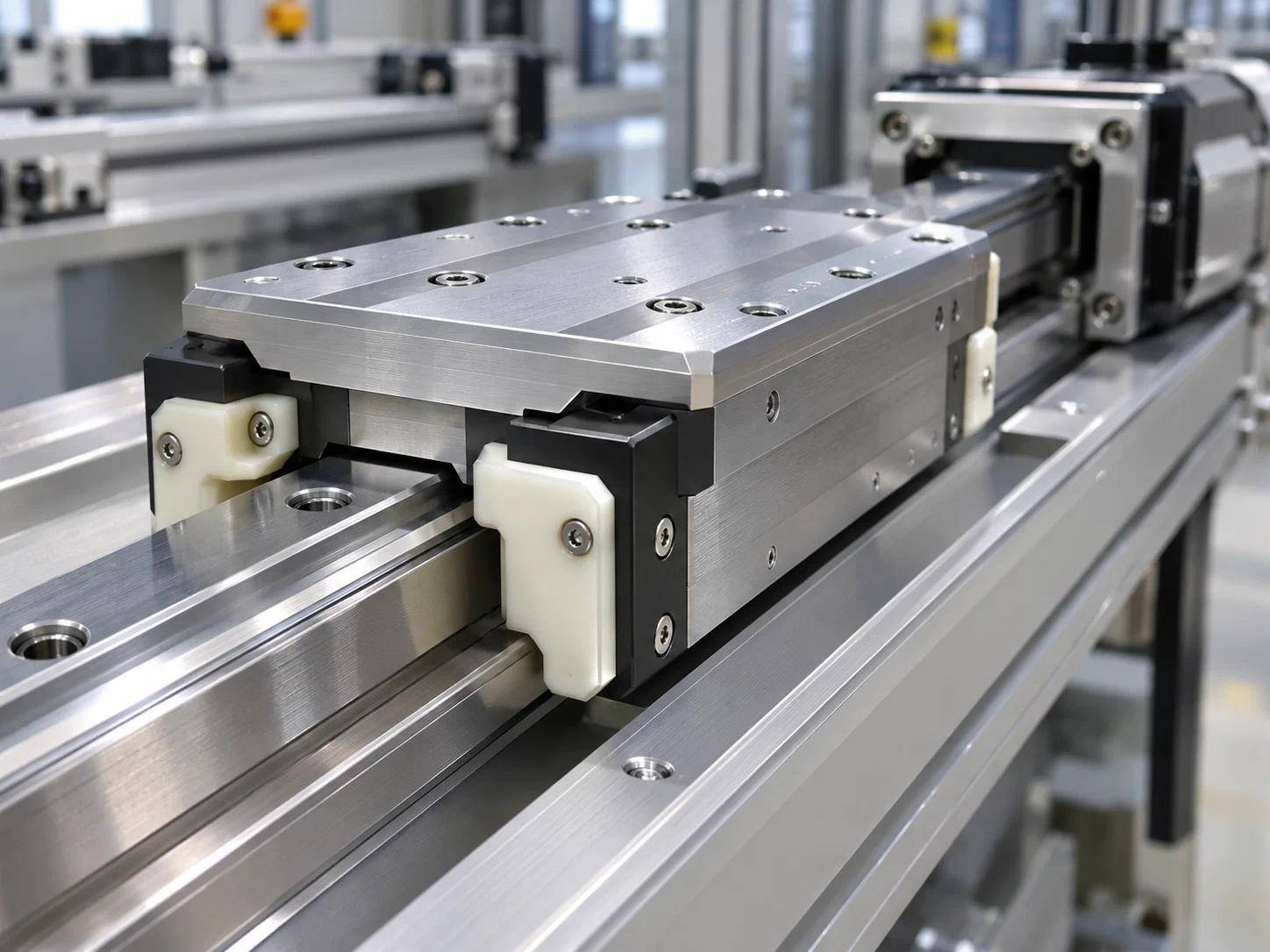
In industrial automation equipment, linear modules perform important functions such as workpiece handling, precision positioning, repetitive movement, and automated assembly. To maintain stable motion, these systems may incorporate guide sliders, wear pads, positioning supports, and travel-limit components. Although relatively small, these plastic functional parts directly influence clearance between moving components, operating resistance, and long-term positioning stability. During continuous reciprocating operation, sliding contact surfaces are exposed to repeated friction and mechanical loading. Conventional components may gradually develop surface wear, increased clearance, operating noise, or localized deformation, eventually affecting the performance of the entire motion system.
The primary function of a customized wear-resistant plastic slider is not simply to allow two components to move relative to each other. It must maintain stable guidance, support, and positioning within the specified motion range. Auxiliary guide sliders help restrict lateral displacement, wear pads withstand continuous sliding contact, positioning supports maintain the relative location of critical structures, and travel-limit components provide protection at the end of movement. These components perform different functions and should be developed according to the equipment structure, movement direction, load distribution, and available installation space rather than simply adapting standard plastic blocks to different dimensions.
Wear and changing clearances are common challenges in linear modules operating through repeated motion cycles. A system may perform normally during initial operation, but after extended use, gradual wear at sliding contact surfaces can increase the original clearance. When a slider can no longer maintain stable guidance, moving components may develop slight lateral movement, affecting repeatability and positioning performance. Some equipment may also experience inconsistent sliding resistance, operating noise, or localized jamming. If contact area, loading direction, and mounting methods are not properly considered during development, simply using a higher-strength material may not improve long-term performance.
Consider a typical development scenario involving an automated handling module. An internal plastic guide slider operates continuously against a metal guide surface. Initial assembly and operating tests are successful, but after extended operation, some sliders begin to show contact-surface wear, increased operating noise, and changes in movement clearance. Further investigation reveals that the slider experiences continuous lateral loading as well as impact forces generated during equipment acceleration and deceleration. The original design has a relatively small contact area, resulting in localized loading, while insufficient support around the mounting position further concentrates wear in specific areas. A more effective development approach is to review contact-surface width, guide length, mounting structure, and local wall thickness, then optimize load distribution according to the actual motion path rather than simply increasing component thickness or selecting a harder material.
Structural design must also account for running clearance and assembly tolerances. Excessive clearance may allow lateral movement and vibration, while insufficient clearance can increase sliding resistance and create a risk of jamming when temperatures change, component dimensions vary, or particles enter the contact area. The slider should therefore be designed according to guide dimensions, operating speed, working loads, and environmental conditions. For structures with multiple guiding surfaces, dimensional consistency between contact areas is also important to prevent uneven loading and localized wear. For replaceable wear sliders, mounting methods, maintenance access, and repeatable positioning after replacement should be considered from the beginning.
In some automated production environments, dust, metal particles, and other contaminants can also affect long-term slider performance. When particles enter the guiding interface, they may cause additional abrasion and change the original clearance. Equipment with lubrication restrictions requires further evaluation of sliding friction, material wear, and the effect of wear debris on nearby products or mechanisms. The development of wear-resistant plastic sliders should therefore consider more than material hardness. Actual sliding speed, contact pressure, operating temperature, contamination, and maintenance intervals all need to be evaluated.
Depending on the loading and motion requirements, wear-modified PA6, PA66, and other suitable engineering plastics can be considered. For functional components requiring a balance of mechanical strength, toughness, and sliding performance, customized material modification can help adjust the formulation. However, final performance must be validated with the actual mating surfaces. Reinforced materials can improve structural stiffness, but glass fibers and other reinforcing components may also affect the wear of contacting surfaces. Material strength alone should not determine the final solution.
During volume production, mold design and injection molding conditions also influence slider performance. Guide sliders often incorporate multiple contact surfaces, mounting holes, retaining slots, and localized reinforcing structures. Uneven molding shrinkage or unstable control of critical dimensions can result in inconsistent assembly clearances. For precision-mating functional parts, particular attention should be given to sliding-surface flatness, critical dimensions, hole positions, and dimensional variation between production batches. TechInherit specializes in customized functional plastic component development, optimizing slider geometry, contact areas, and mounting structures according to equipment drawings and operating requirements. Material modification, mold development, and precision injection molding can be coordinated to support the complete development process from functional design to volume production.
Validation of long-term motion components should go beyond dimensional inspection and initial assembly tests. Continuous reciprocating motion testing is necessary to monitor sliding resistance, contact-surface wear, clearance changes, and operating noise. Depending on the application, additional testing under lateral loads, acceleration and deceleration impacts, and particulate contamination can help evaluate structural stability over extended operation. Integrating component geometry, material formulation, mold design, and actual motion testing is essential for improving the reliability of customized plastic sliders.
For industrial automation manufacturers, the value of customized wear-resistant plastic sliders lies in addressing special structural and motion requirements that standard components may not fully accommodate. When existing guide components experience excessive wear, unstable clearance, operating noise, or mounting incompatibility, developing a customized functional plastic component can provide a more targeted solution. Through appropriate structural optimization and precision manufacturing, manufacturers can reduce abnormal wear, maintenance frequency, and equipment downtime while improving the long-term stability of automated systems.
Request a Free Design Review
Looking to reduce the cost of your next plastic injection molding project? Contact our engineering team today for a free consultation.
