
High-Performance Engineering Plastics Become an Important Material Choice for Electronic Product Structural Components
With the rapid development of consumer electronics, smart devices, and industrial electronic equipment, manufacturers are facing increasing demands for lightweight, durable, and high-performance structural components.
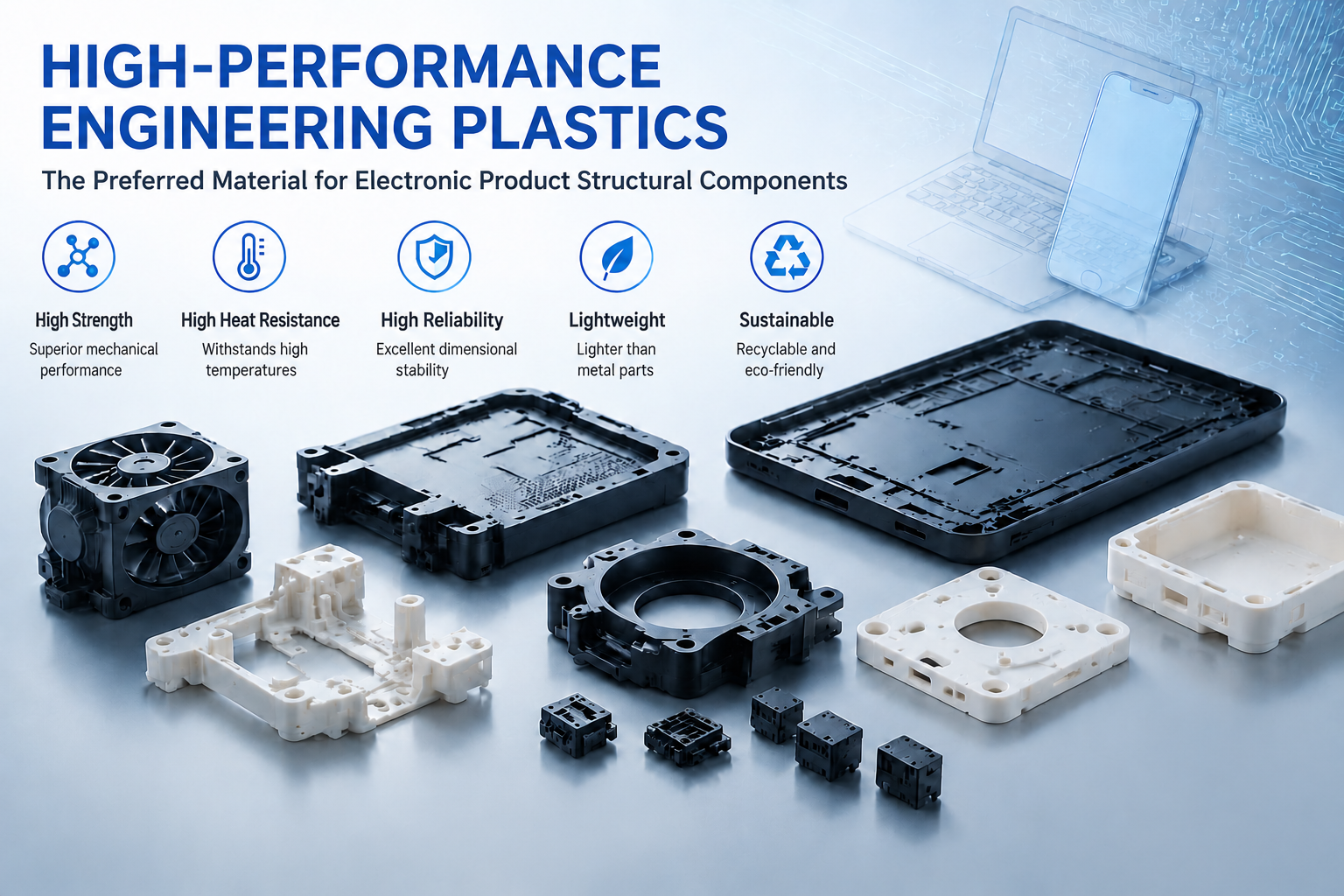
Traditional metal components have been widely used in electronic products for many years. However, challenges such as higher manufacturing costs, complex processing requirements, and heavier weight have encouraged manufacturers to explore alternative materials. As a result, high-performance engineering plastics are becoming an increasingly important choice for electronic product structural components.
Engineering Plastics Provide Excellent Performance for Electronic Applications
Engineering plastics offer superior mechanical and thermal properties compared with standard plastics, making them suitable for demanding applications.
Materials such as PC (Polycarbonate), PA (Nylon), and PBT are widely used in electronic components due to their excellent performance.
PC material provides high impact strength, good dimensional stability, and excellent toughness. It is commonly used for electronic housings, protective covers, transparent components, and precision structural parts.
PA material offers high mechanical strength, wear resistance, and heat resistance, making it suitable for connectors, brackets, gears, and other functional components.
PBT material provides excellent electrical insulation properties and thermal stability, making it widely used in electronic connectors and electrical components.
Through proper material selection, manufacturers can achieve better product reliability while meeting strict performance requirements.
Lightweight Design Drives the Growth of Plastic Structural Components
As electronic products continue to become smaller and lighter, lightweight design has become a key trend in product development.
Compared with metal parts, engineering plastic components provide several advantages:
- Lower product weight and improved portability;
- Higher production efficiency through injection molding;
- Greater design flexibility for complex structures;
- Reduced manufacturing and assembly costs.
Injection molding technology allows complex plastic structures to be produced efficiently while maintaining consistent quality during mass production.
Precision Injection Molding Improves Plastic Component Manufacturing
The performance of engineering plastics depends not only on the material itself but also on advanced manufacturing processes.
Electronic structural components often require high dimensional accuracy, complex geometries, and stable production performance. Therefore, professional manufacturing processes are essential before mass production.
Key factors include:
- Design for Manufacturing (DFM) analysis;
- Mold structure optimization;
- Gate location design;
- Material flow analysis;
- Injection parameter optimization.
By optimizing product design and molding processes, manufacturers can effectively reduce common defects such as warpage, sink marks, weld lines, and dimensional variations.
Future Applications of Engineering Plastics in Electronics Manufacturing
With the continuous growth of smart devices, artificial intelligence equipment, industrial automation, and consumer electronics, the demand for high-performance plastic components will continue to increase.
Engineering plastics will play an important role in applications including:
- Electronic device housings;
- Precision connectors;
- Internal support structures;
- Industrial electronic components;
- Smart equipment components.
Selecting the right material and combining it with professional mold design and injection molding capabilities are essential for achieving stable and efficient mass production.
As a professional plastic manufacturing partner, techinherit provides integrated solutions from material selection, mold design, precision injection molding, and assembly, helping customers develop reliable and high-quality plastic structural components.
Request a Free Design Review
Looking to reduce the cost of your next plastic injection molding project? Contact our engineering team today for a free consultation.
