
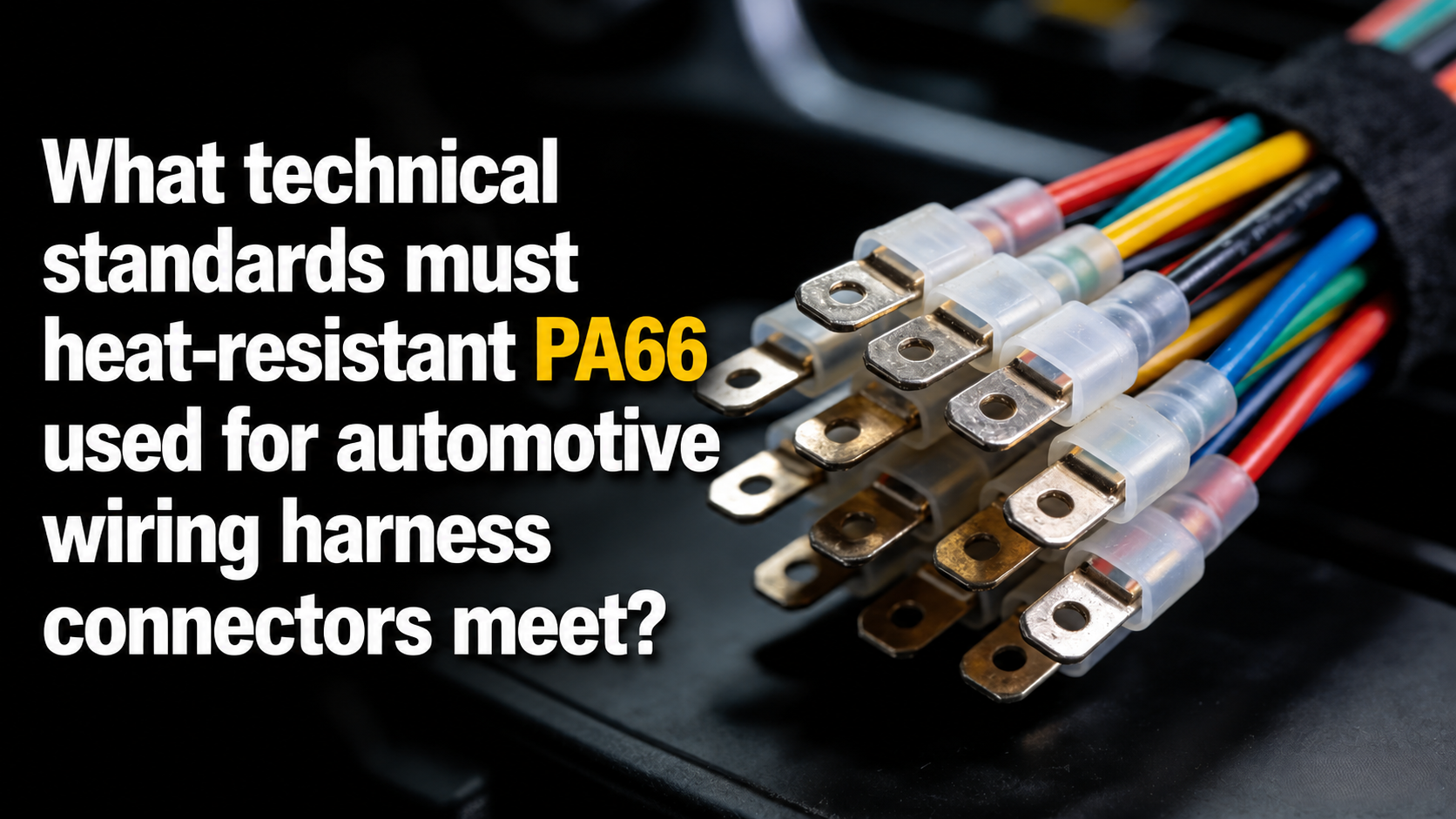
Automotive wire harness connectors are key components for circuit signal transmission, operating in complex and variable environments: high temperatures in the engine compartment, vibration in the chassis area, and repeated damp heat in door areas all place extremely high demands on materials. Heat-resistant PA66, with its good rigidity, dimensional stability, high temperature resistance, and moderate cost, has become the preferred material for the vast majority of wire harness connectors.
However, not all ordinary PA66 can be used for automotive connectors; it must meet a complete set of strict automotive-grade technical standards.
I. HEAT RESISTANCE AND THERMAL PERFORMANCE STANDARDS (CORE REQUIREMENT)
1. Melting point and long-term service temperature
Melting point generally required ≥250°C. Long-term service temperature: -40°C to 125°C (can reach 150°C around the engine)
2. Heat Deflection Temperature (HDT)
Glass-fiber reinforced PA66 HDT ≥220°C, ensuring no softening, deformation, or loss of clamping force at high temperatures.
3. Thermal-oxidative aging stability
After 1000 hours of aging at 125°C, retention rate of tensile and impact strength ≥70%. No brittle cracking, no chalking, no failure.
II. MECHANICAL PERFORMANCE STANDARDS (ENSURING CLAMPING AND VIBRATION RESISTANCE)
1. Tensile strength, flexural modulus
Ensure the structural strength of connector mating and locking mechanisms.
2. Notched impact strength
Must meet requirements at both room temperature and low temperature (-40°C). No brittle fracture under driving vibration and low-temperature environments.
3. Dimensional stability
Low water absorption, low molding shrinkage. Ensure stable terminal contact, reliable insertion and withdrawal, and no looseness.
III. ELECTRICAL PERFORMANCE STANDARDS (CIRCUIT SAFETY)
1. Insulation performance
Volume resistivity and dielectric strength meet standards.
2. Comparative Tracking Index (CTI)
Generally required CTI ≥300V to 600V. Prevent leakage and breakdown under high voltage and humid environments.
3. Arc resistance
Meet automotive electrical safety regulations.
IV. ENVIRONMENTAL RELIABILITY STANDARDS (WEATHER AND MEDIA RESISTANCE)
1. Damp heat resistance
Performance remains stable after 85°C/85% RH damp heat test.
2. Chemical resistance
Resistant to engine oil, coolant, cleaning agents, and electrolyte.
3. Low-temperature performance
No brittle cracking at -40°C, meeting the requirements for use in northern and extremely cold regions.
V. AUTOMOTIVE INDUSTRY ENVIRONMENTAL AND COMPLIANCE STANDARDS
1. RoHS / REACH compliance
Free of harmful substances such as heavy metals and polybrominated biphenyls.
2. Low VOC, low odor
Meet interior air quality requirements.
3. IATF 16949 system requirements
Material batch stability and traceability.
VI. PROCESSING AND MASS PRODUCTION STABILITY STANDARDS
1. Good injection molding flowability
Suitable for small connector structures and multi-cavity molds.
2. Low warpage, low shrinkage
High assembly precision, no sticking or loose fitting.
3. Minimal batch-to-batch performance variation
Meet the requirements of large-volume, long-term supply for automobiles.
Request a Free Design Review
Looking to reduce the cost of your next plastic injection molding project? Contact our engineering team today for a free consultation.
