
How Glass Fiber Reinforcement Changes the Performance of PA66
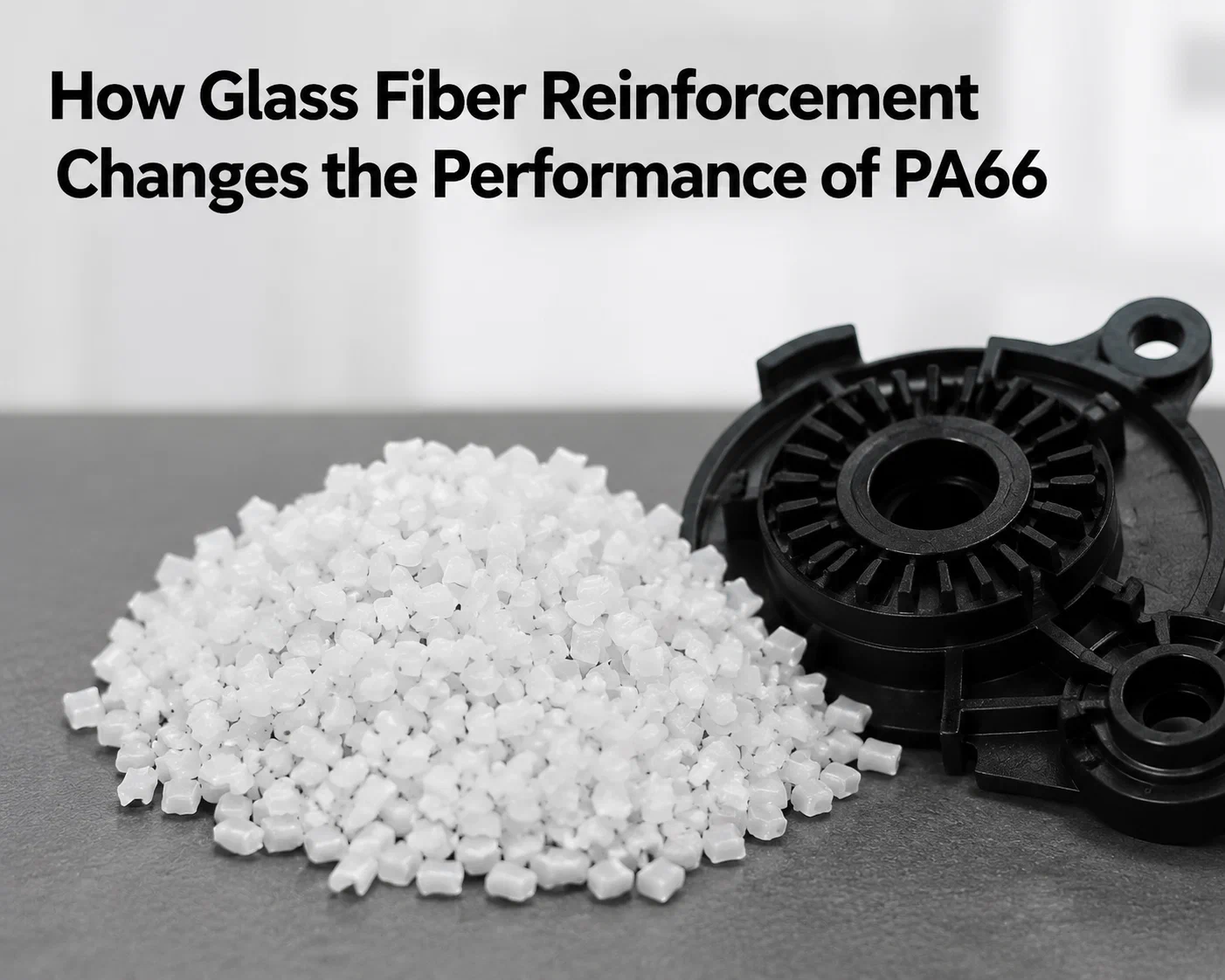
PA66 engineering plastic is widely used in plastic component manufacturing because of its excellent mechanical properties, wear resistance, and heat resistance. However, standard PA66 materials may not always provide sufficient performance for applications that require higher structural strength and long-term dimensional stability. Glass fiber reinforcement is one of the most effective material modification technologies used to enhance the performance of PA66.
Glass fiber reinforced PA66 is produced by adding glass fibers into the nylon matrix during the compounding process. The reinforced structure allows the material to carry higher loads and maintain better stability under mechanical stress. Common grades such as PA66 GF30 are widely used in engineering plastic applications that require improved structural performance.
One of the most noticeable changes after glass fiber reinforcement is the increase in mechanical strength. Compared with unreinforced PA66, reinforced materials provide significantly higher tensile strength and flexural strength. This allows plastic components to withstand greater forces without excessive deformation or failure.
Stiffness is also greatly improved by glass fiber reinforcement. Standard PA66 offers good toughness, but reinforced PA66 becomes much more rigid, making it suitable for structural components that need to maintain shape under load. Increased rigidity helps reduce bending and improves overall component stability.
Another important advantage is improved dimensional stability. During injection molding and product use, standard nylon materials may experience shrinkage and deformation caused by temperature changes and internal stress. Glass fiber reinforced PA66 reduces these effects and helps maintain more accurate dimensions, especially for precision plastic components.
Heat resistance is also enhanced through reinforcement. Glass fibers help improve the thermal performance of PA66, allowing the material to retain better mechanical properties at elevated temperatures. This makes reinforced PA66 suitable for applications where temperature stability is an important requirement.
The reinforcement process also influences injection molding behavior. Reinforced PA66 has lower mold shrinkage than standard PA66, which can improve dimensional consistency. However, processing conditions such as injection pressure, mold temperature, and cooling control become more important to achieve optimal results.
Material orientation is another factor that affects performance. During injection molding, glass fibers tend to align with the flow direction of the molten material. This orientation can create different mechanical properties in different directions, so proper mold design and gate location are important for achieving balanced performance.
PA66 GF30 is one of the most commonly used reinforced nylon grades because it offers a good balance between strength, stiffness, processability, and cost. It is widely selected for applications that require durable and reliable engineering plastic components.
In addition to mechanical improvements, reinforced PA66 can also contribute to lightweight design. By replacing certain metal components with high-strength reinforced nylon, manufacturers can reduce product weight while maintaining sufficient structural performance. This approach supports more efficient product design and manufacturing.
Choosing the right glass fiber reinforced PA66 grade depends on product requirements, including load conditions, temperature exposure, dimensional accuracy, and processing methods. Material selection should be combined with proper mold design and injection molding optimization to achieve the best overall performance.
Techinherit provides customized engineering plastic solutions, including PA66 GF reinforced materials, high-strength nylon compounds, and performance-optimized material development. Through material modification and manufacturing support, we help customers develop reliable plastic components for demanding applications.
Request a Free Design Review
Looking to reduce the cost of your next plastic injection molding project? Contact our engineering team today for a free consultation.
