
Why Is DFM Analysis Important Before Mass Production?
1. Reduce Injection Molding Defects
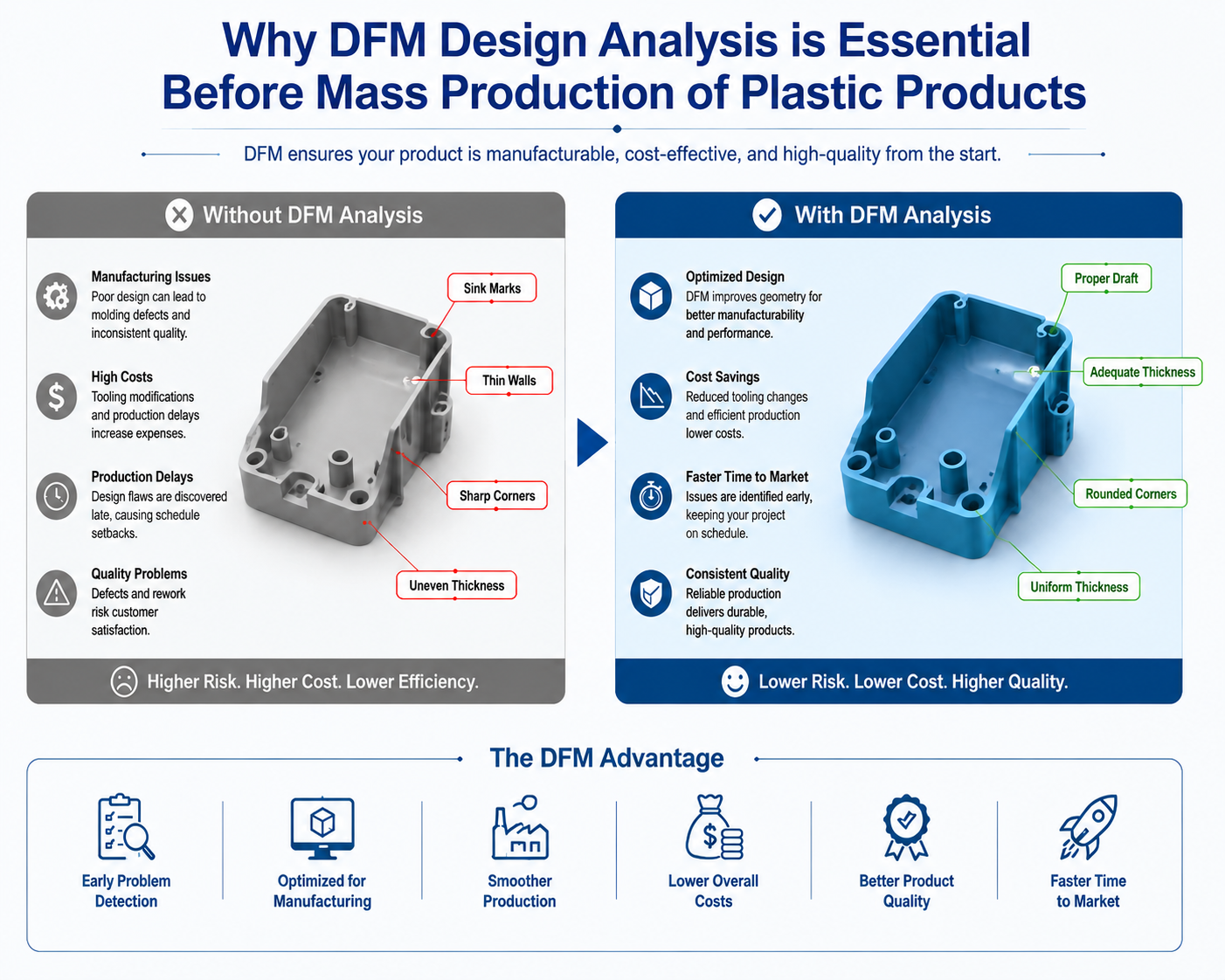
A poorly designed plastic part may cause various molding defects during production.
Common problems include:
- Sink marks
- Warpage
- Weld lines
- Short shots
- Flash
- Uneven shrinkage
Through DFM analysis, engineers can optimize product geometry and improve material flow, helping reduce defects before production starts.
2. Improve Plastic Product Structure Design
The structure of a plastic component directly affects its strength, appearance, and manufacturability.
DFM analysis helps optimize important design elements such as:
Wall Thickness
Uneven wall thickness can lead to:
- Different cooling rates
- Internal stress
- Product deformation
Optimized wall thickness improves molding stability and dimensional accuracy.
Ribs and Bosses
Ribs and bosses are commonly used to increase structural strength.
However, incorrect design may create:
- Surface sink marks
- Poor filling performance
- Weak areas
DFM review helps ensure these features provide strength without affecting product quality.
3. Improve Mold Design Feasibility
The mold is one of the most important factors affecting injection molding performance.
Before mold manufacturing, DFM analysis can help evaluate:
- Parting line location
- Ejection direction
- Mold complexity
- Gate position
- Cooling requirements
Early identification of mold-related issues reduces the possibility of costly mold modifications after production begins.
4. Reduce Product Development Costs
Making design changes after mold production can be expensive and time-consuming.
DFM analysis helps manufacturers:
- Reduce mold modification costs
- Shorten development cycles
- Minimize trial production issues
- Improve first-time production success
By solving potential problems during the design stage, companies can achieve faster and more cost-effective product development.
5. Improve Mass Production Stability
A well-designed plastic product is easier to manufacture consistently.
DFM optimization helps achieve:
- Stable injection molding processes
- Consistent product dimensions
- Higher production efficiency
- Lower rejection rates
This is especially important for high-volume plastic components used in automotive, electronics, industrial equipment, and consumer products.
Plastic Products That Benefit From DFM Analysis
Automotive Plastic Components
Automotive plastic parts often require high strength, dimensional accuracy, and long-term reliability.
Examples include:
- Connector housings
- Structural brackets
- Sensor components
- Electrical components
Industrial Plastic Components
Industrial products require excellent mechanical performance and durability.
Examples include:
- Machine parts
- Equipment housings
- Functional components
- Precision plastic assemblies
Consumer Product Components
Many consumer products rely on injection molded plastic parts for lightweight and cost-effective manufacturing.
Examples include:
- Electronic housings
- Appliance components
- Smart device parts
DFM Analysis Process for Plastic Product Manufacturing
A typical DFM workflow includes:
Product Concept
↓
3D Design Review
↓
DFM Analysis
↓
Mold Design Optimization
↓
Prototype Validation
↓
Mass Production
This process ensures that product design, mold manufacturing, and injection molding production work together efficiently.
Request a Free Design Review
Looking to reduce the cost of your next plastic injection molding project? Contact our engineering team today for a free consultation.
