
In PA6/PA66 injection molding production, problems such as brittle fracture, yellowing, dimensional fluctuation, and substandard performance often arise not from improper process adjustments, but from raw material degradation that has not been identified in advance. The amide groups in PA6/PA66 molecular chains are extremely sensitive to heat, oxygen, moisture, and ultraviolet light. Even unopened raw material, when improperly stored or kept beyond its shelf life, can gradually undergo molecular chain degradation and additive decomposition, resulting in irreversible aging and deterioration. Identifying whether the raw material has aged in advance is the core prerequisite for ensuring production stability and yield compliance, and is far more important than solving product problems after the fact.
I. CORE CAUSES OF PA6/PA66 RAW MATERIAL AGING AND DETERIORATION
To accurately determine whether the raw material has aged, one must first clarify the core causes of aging. The aging characteristics and performance changes caused by different factors show obvious differences and can be divided into four core categories:
1. Thermo-oxidative Aging: This is the most common form of aging. When the storage environment temperature is too high or the material undergoes repeated high-temperature melting during processing, the PA6/PA66 molecular chains break, the molecular weight continuously decreases, and oxidative yellowing occurs simultaneously. The toughness and strength of the material will gradually decline. Even when stored at room temperature for a long time, slow thermo-oxidative aging will occur.
2. Hydrolytic Aging: PA6/PA66 are highly hygroscopic materials. After the raw material absorbs moisture, under high-temperature and high-humidity environments, the molecular chains undergo hydrolytic cleavage, directly causing a precipitous drop in mechanical properties. This is also the core reason why many moisture-affected raw materials, even after thorough drying, still exhibit brittleness and substandard performance after injection molding.
3. Additive Failure: Functional additives such as flame retardants, toughening agents, antioxidants, and lubricants added to modified PA6/PA66 will gradually decompose, migrate, and fail over time, with environmental temperature, and with light exposure. For example, after the antioxidant fails, the anti-aging ability of the raw material will drop significantly. After the flame retardant fails, the product will not pass flame retardancy compliance tests. Even if the appearance is normal, this constitutes functional aging and deterioration.
4. Photo-aging: When the raw material is exposed to direct sunlight for a long time, ultraviolet light directly destroys the molecular chain structure, leading to rapid yellowing and embrittlement. For general-purpose grades that have not been modified for weathering resistance, the photo-aging rate will accelerate exponentially.
II. THREE-LEVEL EVALUATION METHOD FOR PA6/PA66 RAW MATERIAL AGING AND DETERIORATION
Following the logic from easy to difficult and from low-cost to high-precision, we have organized a three-level evaluation method, covering the full range of scenarios from rapid on-site screening in the workshop to precise verification before batch production, which can be directly implemented.
Level 1: Visual and Sensory Rapid Identification (Zero Cost, Preliminary Screening Completed On-Site in 1 Minute)
This is the most basic and convenient screening method, requiring no instruments and can be performed in the warehouse or workshop to directly screen out severely aged raw materials. Focus on 4 key dimensions:
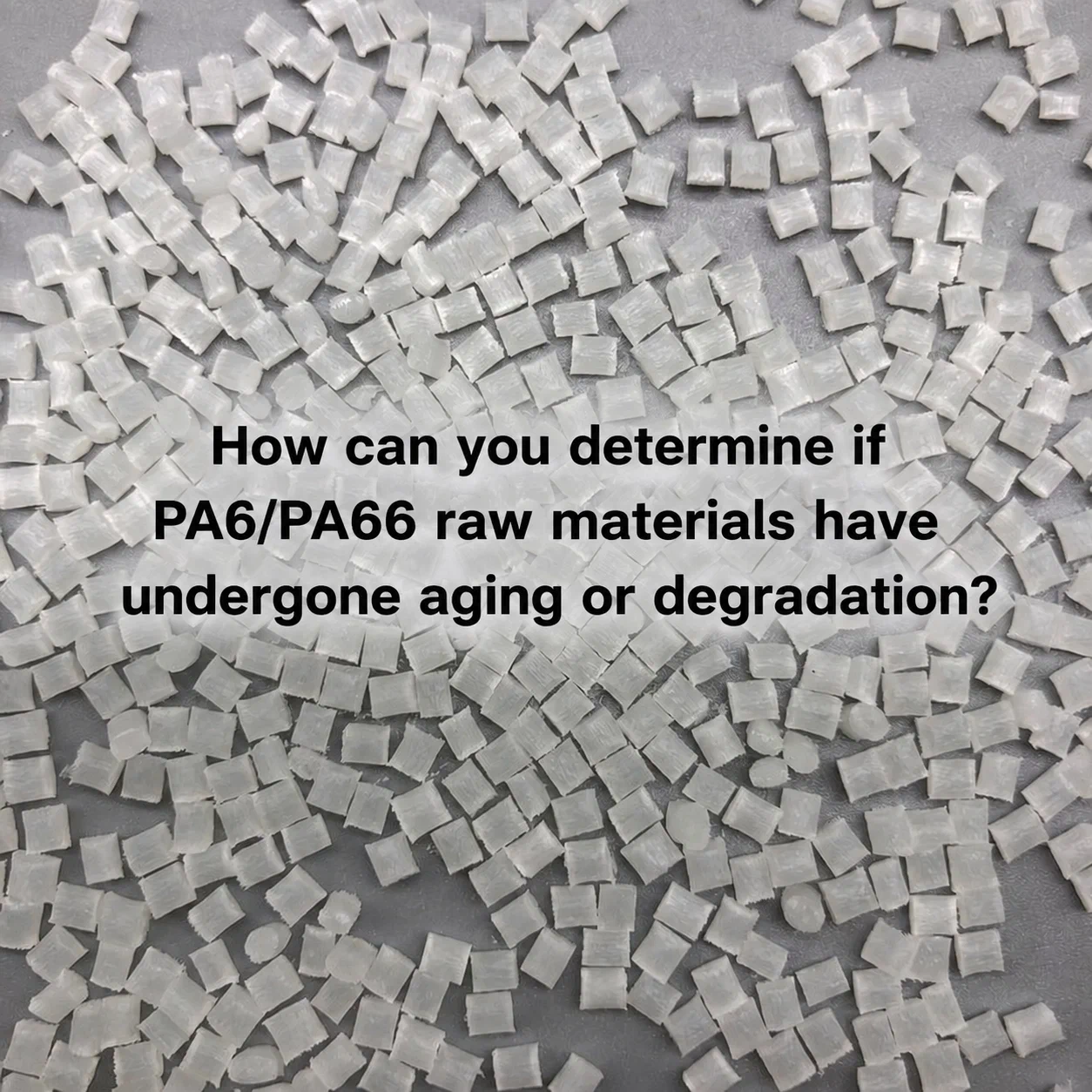
1. Appearance Color Change: This is the most intuitive characteristic of aging. Normal PA6/PA66 pellets are uniformly milky white, translucent, or natural in color, with consistent color and no discoloration. If the raw material shows overall yellowing, localized darkening, brown spots, or becomes dull and grayish—even if it is only slight yellowing—it indicates that thermo-oxidative aging has occurred. The deeper the degree of yellowing, the more severe the aging. For glass-fiber reinforced or mineral-filled modified grades, normal color is light milky white. Uneven color or yellowing is also a clear signal of aging.
2. Abnormal Pellet Condition: Normal PA6/PA66 pellets are uniformly cylindrical or ellipsoidal, with a smooth surface, no sticking, no powdering, and no cracking. If the raw material shows pellet agglomeration and caking, surface powdering, or edge cracking, and crumbles easily when gently squeezed by hand, it indicates that the molecular chains have been significantly degraded. This is severe aging, and the original toughness has been completely lost.
3. Abnormal Odor: Normal PA6/PA66 raw material, at room temperature, only has a slight inherent resin odor and no pungent, irritating smell. If a pungent sour smell, burnt smell, or odor from additive decomposition can be detected at room temperature, it indicates that the functional additives in the material have decomposed and the molecular chains have degraded. This is severe aging and deterioration, and the material must never be used directly for production.
4. Abnormal Packaging Condition: If the vacuum aluminum-foil packaging of the raw material shows air leakage, damage, bulging, or has internal condensation and water droplets, it means the material has been in prolonged contact with air and moisture. Hydrolytic aging has likely already occurred. Even within the nominal shelf life, further testing must be conducted, and it cannot be put into production directly.
Level 2: Simple Performance Tests (Workshop-Operable, Quick Verification of Aging Degree)
If there is no obvious abnormality visually, but the material is near its shelf life, the packaging has minor damage, or the storage environment once exceeded temperature and humidity limits, further verification of whether the material has aged can be done through simple tests that can be completed in the workshop. There are 3 core methods:
1. Standard Test Specimen Injection Molding Test: Take a small amount of raw material, dry it thoroughly according to standard process parameters, and then injection mold standard tensile and impact test specimens. Directly observe the condition of the specimens. If persistent silver streaks, bubbles, or pits appear on the specimen surface, and the drying process is fully compliant yet cannot be eliminated through repeated debugging, it indicates that the raw material has undergone hydrolytic aging and molecular chain degradation, producing low-molecular-weight volatiles. If the specimen exhibits brittle fracture or chipping right at demolding, it indicates that the material's toughness has significantly decreased and the degree of aging is deep.
2. Bending Embrittlement Test: Take the injection-molded standard test bar and perform a 180-degree bending test at room temperature. A normal PA6/PA66 test bar will only show plastic deformation after bending and will not fracture directly. If the test bar fractures in a brittle manner upon slight bending with no significant deformation process, it means the notched impact strength and elongation at break of the raw material have dropped dramatically due to aging, and it can no longer meet the usage requirements for structural parts.
3. Melt State Observation: Take a small amount of raw material into the injection molding machine barrel, melt it at standard temperature, and observe the melt state. Normal PA6/PA66 melt is uniform and glossy with stable flowability. If the melt appears yellowed, blackened, has burnt spots, and the flowability fluctuates significantly compared to the nominal value, it indicates that the molecular chains have degraded and the molecular weight has dropped, which is definite aging and deterioration.
Level 3: Professional Instrument Testing (Final Confirmation Before Batch Production, Precise Quantification of Aging Degree)
For large batches of raw materials and high-requirement products (automotive structural parts, electrical flame-retardant parts, food contact parts), testing with professional instruments is mandatory to quantify the aging degree and avoid batch production risks. The core tests measure 4 key indicators:
1. Melt Flow Rate (MFR) Test: This is the core indicator for judging whether PA6/PA66 has degraded and aged. The MFR of normal raw material will be within the manufacturer's nominal range, fluctuating no more than ±20%. If the tested MFR is significantly higher than the nominal value, it indicates that molecular chains have cleaved and degraded, the molecular weight has dropped, and the higher the increase, the more severe the aging. If the MFR decreases significantly, it indicates that crosslinking aging has occurred, which is also a severe form of deterioration.
2. Mechanical Property Test: Use a universal testing machine and impact tester to measure the tensile strength, elongation at break, and notched impact strength of the raw material. For aged material, tensile strength decreases slightly, while elongation at break and notched impact strength show a cliff-like drop. If the impact strength drops by more than 30%, it indicates that the raw material has aged severely and cannot be used for load-bearing structural parts.
3. Yellowness Index Test: Use a colorimeter to measure the Yellowness Index (YI) of the raw material. The YI of normal natural-grade PA6/PA66 is generally below 10. A YI exceeding 15 indicates that significant thermo-oxidative aging has occurred. The higher the value, the deeper the degree of aging.
4. Fourier Transform Infrared Spectroscopy (FTIR) Test: Through FTIR testing, changes in the amide groups and oxidative groups in the raw material's molecular chains can be visually observed, allowing precise judgment of whether oxidation or hydrolytic degradation has occurred. It can also detect whether functional additives have decomposed and failed, making it a professional method for determining the aging mechanism.
III. HAZARDS OF AGED AND DETERIORATED PA6/PA66 RAW MATERIALS AND GRADED DISPOSAL METHODS
Core Hazards of Aged Raw Materials
1. Production Aspect: The flowability of aged raw material fluctuates greatly, leading to unstable mold filling, batch out-of-tolerance product dimensions, and frequent appearance defects that cannot be completely resolved just by machine adjustments. The yield rate drops significantly. In severe cases, screw slippage, material accumulation and burning in the barrel can occur, damaging production equipment.
2. Performance Aspect: The mechanical properties of aged raw material plummet. Products will exhibit brittle fracture, cracking under screw tightening, and a significantly shortened service life. Especially for automotive, electrical, and load-bearing structural parts, this poses serious safety hazards. After additives in modified materials fail, functions such as flame retardancy, weather resistance, and hydrolysis resistance will be completely lost, causing failure in compliance testing and resulting in batch rejection.
3. Compliance Aspect: When food-contact-grade and medical-grade raw materials age, low-molecular-weight substances can leach out and harmful migration levels can exceed standards, causing them to fail safety certifications and face the risk of compliance penalties.
Graded Disposal Methods for Aged Raw Materials
1. Slight Aging: Only slight yellowing is present, MFR fluctuation is within ±20%, mechanical property decline is no more than 10%, with no odor and no powdering. This type of material can be mixed with qualified virgin material at a ratio of 10%-20% and used only for non-load-bearing, non-safety-related general appearance parts. It is strictly prohibited for use in food contact, electrical, and automotive safety parts.
2. Moderate Aging: Noticeable yellowing, MFR fluctuation exceeds 20%, mechanical property decline is 10%-30%, and test bar bending shows slight embrittlement. This type of material is strictly prohibited for any structural or functional parts. It can only be downgraded for use in low-requirement civilian filler parts, disposable non-load-bearing products, or handed over to professional recycling manufacturers for recycling and re-modification.
3. Severe Aging: Shows blackening, caking, powdering, and a pungent odor; MFR fluctuation exceeds 50%, mechanical property decline exceeds 30%, and test bar fractures brittlely upon bending. This material has completely lost its use value and must be directly scrapped. It is strictly forbidden to add it to any virgin material to avoid causing greater batch losses.
IV. CORE PREVENTIVE MEASURES TO DELAY PA6/PA66 RAW MATERIAL AGING AND DETERIORATION
1. Strictly implement standardized storage: control the temperature and humidity of the storage environment, store away from light, sealed, and dry. Strictly enforce the First-In-First-Out (FIFO) principle to prevent materials from being stored beyond their shelf life, thus delaying aging at the source.
2. Strictly control the usage period after opening: unused raw material after opening must be immediately re-sealed under vacuum. Use it up within 15 days. Open storage is strictly forbidden to prevent moisture absorption and oxidation.
3. Reduce repeated processing of raw materials: repeated high-temperature melting of regrind accelerates molecular chain degradation and aging. The regrind addition ratio must not exceed 20%, and it can be reused a maximum of 3 times, preventing aged regrind from affecting the properties of the entire batch.
4. Perform baseline testing before incoming raw material batches enter the warehouse: retain baseline data for MFR, yellowness index, and mechanical properties. Conduct regular sampling and comparison during storage to detect aging signs in advance.
Request a Free Design Review
Looking to reduce the cost of your next plastic injection molding project? Contact our engineering team today for a free consultation.
