
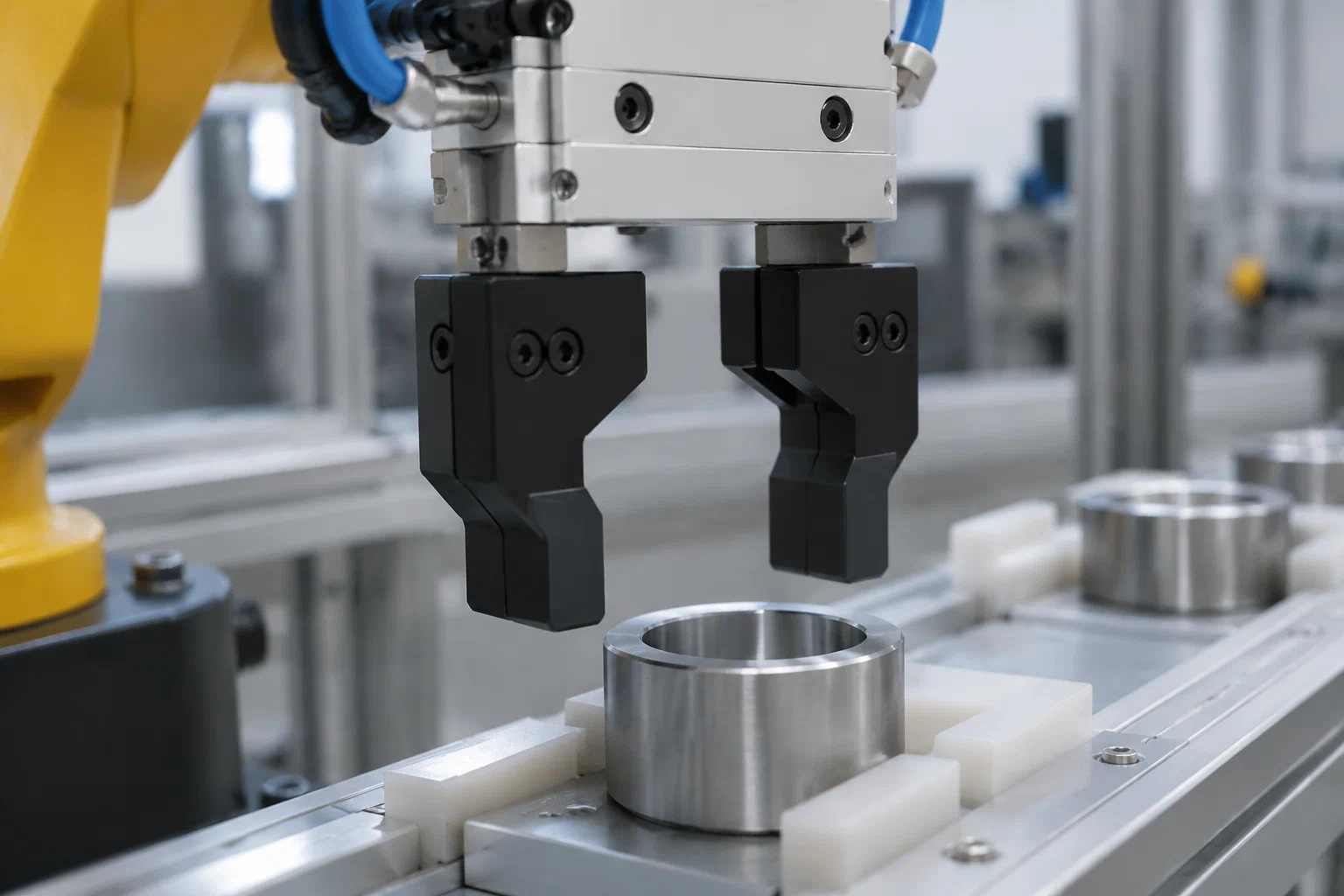
As industrial robots become increasingly common in automated assembly, precision machining, material handling, and production-line transfer, end-of-arm gripping systems face growing demands for reliable handling and positioning accuracy. Conventional metal gripper fingers offer high mechanical strength, but when handling precision-machined components, finished surfaces, or irregularly shaped workpieces, they may create problems such as limited contact areas, concentrated pressure, surface marking, and inconsistent gripping positions. On automated production lines handling multiple product variants, standard gripper designs may also fail to accommodate different workpiece contours and installation spaces. Customized plastic gripping components therefore offer an alternative for selected industrial robotic handling applications.
Custom plastic gripping components are typically installed at the workpiece contact points of robotic end effectors. Common examples include customized gripper fingers, replaceable gripping blocks, contoured positioning inserts, and protective contact pads. Their geometry should be developed according to workpiece shape, weight, gripping direction, and movement path. For components with complex contours, the contact surfaces should follow the workpiece geometry to avoid concentrated pressure at a limited number of contact points. Thin-walled components and finished surfaces require appropriate contact-area and gripping-force control to reduce deformation and surface damage. For workpieces requiring multi-directional handling, sufficient clearance must also be provided between the gripping components and surrounding structures to prevent interference during picking, rotation, and placement.
Unstable gripping does not necessarily indicate a problem with the robot or gripper drive mechanism. In some applications, the actual issue comes from an unsuitable contact geometry. Consider a typical automated handling scenario involving precision-machined metal housings. A robot uses a parallel gripper to pick and transfer housings of different dimensions. The original metal fingers can perform basic gripping operations, but some workpieces begin to slip slightly during high-speed movement, while others develop visible contact marks. Further analysis indicates that the original finger contours do not fully match the workpiece geometry. The effective contact area is limited, and there is insufficient positioning compensation between different product sizes. A customized plastic finger design can improve contour matching, introduce locating features at critical positions, and incorporate appropriate contact-surface characteristics to improve gripping stability and workpiece protection.
The structural design of gripping components also directly affects repeatability. During repeated pick-and-place operations, the workpiece must maintain a consistent position relative to the gripper. Differences in mounting datums, contact contours, or deformation under load can cause positional variations between operating cycles. In automated assembly, precision inspection, and multi-station transfer applications, these deviations may affect downstream assembly positions and machining accuracy. Custom gripping components should therefore control mounting interfaces, contact geometry, locating datums, gripping travel, and assembly tolerances. Robot speed, acceleration, deceleration, and workpiece center of gravity must also be considered when defining the final structure.
For automated production lines handling multiple product variants, replaceable plastic gripping inserts provide another practical design option. Different workpieces may require different contours, contact locations, and gripping conditions. Replacing an entire gripper assembly whenever the product changes can increase changeover time, spare-part requirements, and maintenance costs. By developing a standardized mounting interface with workpiece-specific plastic contact inserts, manufacturers can retain the existing gripper body while replacing only the components that directly contact the product. The design must also consider repeatable positioning after replacement, secure retention, and error-proof installation to support reliable production changeovers.
Material selection should be based on workpiece weight, gripping pressure, contact friction, and operating conditions. Modified PA6, PA66, and other suitable engineering plastics can be evaluated according to the application. Reinforced engineering plastics may be considered for gripping structures requiring greater stiffness, while separate compliant contact features may be appropriate where delicate surfaces require additional protection. Material selection should not be based on mechanical strength alone. Contact wear, workpiece surface condition, and long-term operating cycles must also be validated. Plastic gripping components do not automatically increase the gripping capacity of the robot. Gripping force, workpiece mass, acceleration, and the gripper manufacturer's allowable loads and moments must remain within the specified operating limits.
From customized product development to volume production, component geometry, tooling, and injection molding quality must be controlled together. Gripper fingers often incorporate irregular contact contours, mounting holes, locating slots, and localized reinforcing structures. Poor mold design or unstable molding shrinkage can result in contact-surface deviations, asymmetry between paired fingers, and inconsistent mounting positions. For components requiring high positioning accuracy, particular attention should be given to critical contact dimensions, mounting datums, and dimensional variation between production batches. TechInherit specializes in customized functional plastic components and can develop gripping structures according to the customer's robot gripper model, workpiece drawings, handling method, and operating environment. Material modification, mold development, and precision injection molding can be coordinated throughout the development process.
Validation of gripping components intended for long-term robotic operation should extend beyond initial assembly and static holding tests. Repeated pick-and-place testing is necessary to check for workpiece slipping, rotation, and surface damage, while also monitoring contact-surface wear, mounting loosening, and positional changes after repeated replacement. For high-speed handling applications, dynamic validation should reflect actual acceleration, deceleration, workpiece mass, and center-of-gravity conditions. Only by evaluating workpiece geometry, gripping structure, contact pressure, mounting accuracy, and actual motion conditions together can customized plastic gripping components achieve reliable performance in automated production.
For industrial robot and automation equipment manufacturers, the value of customized plastic gripping components extends beyond replacing conventional metal contact parts. It lies in solving problems that standard grippers cannot fully address, including special workpiece geometries, inadequate surface protection, unstable gripping positions, and difficult product changeovers. When existing gripping structures cannot meet the requirements of product shape, positioning accuracy, or production cycle time, redesigned functional plastic components and dedicated tooling can provide a more application-specific solution. This helps improve gripping stability, reduce workpiece damage, and increase the overall efficiency of automated manufacturing.
TechInherit welcomes qualified distributors, agents, and regional partners worldwide. As a manufacturer specializing in specialty engineering plastics and customized injection-molded plastic components, we look forward to building long-term partnerships with companies in industrial automation, robotics, and precision manufacturing to develop application-specific plastic functional components.
Request a Free Design Review
Looking to reduce the cost of your next plastic injection molding project? Contact our engineering team today for a free consultation.
